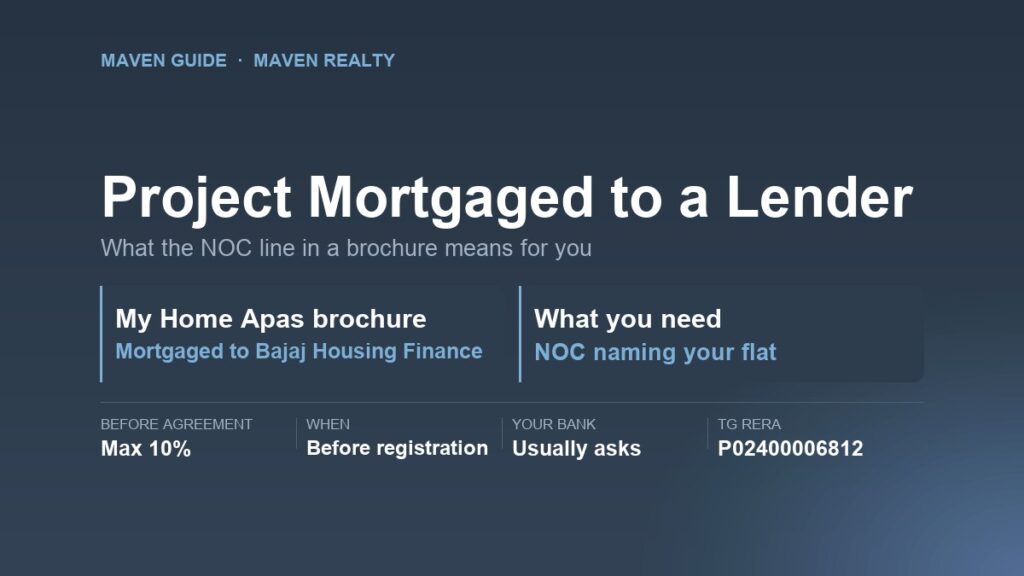
Read the first page of the My Home Apas brochure closely and you’ll find a line most buyers skip: the project is financed by and mortgaged to a lender. That sounds alarming if you haven’t seen it before. It’s actually common, and it’s better printed than hidden. This guide explains what it means when a project is mortgaged to a bank or housing finance company, what the builder NOC from the bank is for, and what to ask before you pay.
Key takeaways
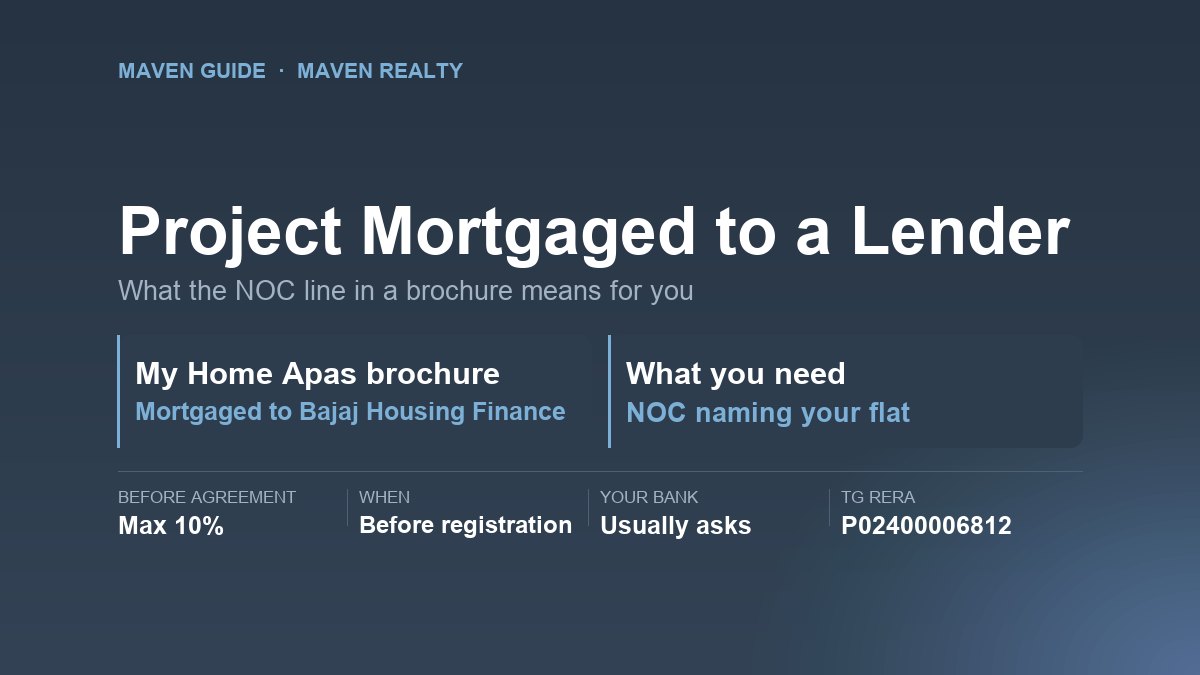
- My Home Apas’s brochure says the project is “financed by & mortgaged to Bajaj Housing Finance Ltd”
- A project mortgaged to a bank is common: builders borrow to fund construction, and the land and unsold flats are usually the security
- The lender’s NOC is what releases your flat from that mortgage when it’s sold to you
- Ask for an NOC that names your flat, and get it before you register
- Under RERA, the builder can’t take more than 10% of the price before a registered agreement for sale
Looking at the project itself? Our My Home Apas page has the towers, sizes, RERA number and construction stage.
In this guide
The Line in the My Home Apas Brochure
Page one of the My Home Apas brochure, below the RERA number and the HMDA building permission, says this:
“Project financed by & Mortgaged to Bajaj Housing Finance Ltd. No objection certificate/permission to Mortgage from Bajaj Housing Finance Limited will be provided for sale of flats.”
Two things are in that sentence. First, a lender has a mortgage over the project. Second, the builder promises that the lender’s no-objection certificate, or permission, will be provided when flats are sold.
That’s all the brochure says. It doesn’t say how much was borrowed or on what terms, and we won’t guess. What matters to you as a buyer is the second half: the NOC.
Why a Project Is Mortgaged to a Bank
Large housing projects cost far more to build than buyers pay up front. Builders cover the gap partly with buyers’ instalments and partly with construction finance from banks and housing finance companies.
A lender wants security for that loan. The usual security is the project itself: the land and the flats that haven’t been sold yet. So when a project is mortgaged to a bank, the lender has a legal claim over it until the loan is repaid.
That’s normal. A project mortgaged to a bank isn’t a red flag by itself. In some ways it’s a mild comfort: a lender looked at the project before putting money in. But it isn’t a guarantee of anything either, and it adds a step to your purchase.
The honest catch: while the mortgage covers your flat, you need the lender’s clearance before the flat is fully yours. That step is easy when the paperwork is in order and slow when it isn’t.
Project Mortgaged to a Bank: What the Builder NOC Does
The NOC, or no-objection certificate, is the lender saying it doesn’t object to a particular flat being sold. In practice it’s how your flat comes out from under the project mortgage when you buy it.
In a project mortgaged to a bank, without it the lender’s claim could still cover your flat after you’ve paid. With it, the lender has agreed that your flat can pass to you.
A builder NOC from the bank usually isn’t a single blanket letter for the whole project. Ask whether the NOC will be issued for your specific flat, naming the tower and unit number. That’s the version that protects you.
The My Home Apas brochure promises that this permission “will be provided for sale of flats”. Your job is to make sure you actually receive it, in writing, for your flat, at the right time.
What to Ask For
When a project is mortgaged to a bank, ask the builder for these, in writing:
- An NOC naming your flat. Tower, floor and unit number, issued by the lender, on the lender’s letterhead.
- When you’ll get it. Ideally before you sign and register the agreement for sale, and certainly before the sale deed.
- What happens to your payments. Ask whether your instalments go to an account linked to the project, and whether the lender has a say over it.
- Confirmation the mortgage will be released. Ask how the release of your flat is recorded when the sale deed is registered.
- A copy of the lender’s sanction terms if possible. Builders often won’t share the full loan document, but they should share what affects your flat.
In any project mortgaged to a bank, if a sales team can’t answer these, ask for the legal team. These are routine questions, and a builder that prints the mortgage on page one should expect them.
Extra charges come up in the same conversation. Our guide to floor rise, PLC and hidden charges lists the rest of what to get in writing.
If You’re Taking a Home Loan
Most buyers of a 3 BHK in Kokapet will borrow, and a project mortgaged to a bank changes how that loan works. If you do, your own lender will usually ask for the builder NOC from the bank that holds the project mortgage. Banks generally won’t release a home loan against a flat that another lender still has a claim on.
So the NOC isn’t just paperwork for later. It can decide when your home loan is disbursed. Ask your bank early what it needs, and ask the builder how fast it can get the project lender’s NOC.
If you’re paying over a long construction period, think about the cost of waiting too. Our guide to the cost of carrying a long possession date works through it.
Ask your own bank whether it has already approved the project. Some lenders keep lists of approved projects, which can make your loan quicker. If it hasn’t, ask what it needs.
What to Check Before You Pay
Before you hand over a large sum on a project mortgaged to a bank:
- Check the registration. Look up the project on the Telangana RERA portal. Project pages often include disclosures and documents. The search needs a captcha, so do it yourself. My Home Apas is P02400006812.
- Ask for the encumbrance details. Ask the builder what charges exist on the land and the project, and get it in writing.
- Keep the advance small. Under the RERA Act, section 13, a builder can’t take more than 10% of the price before a registered agreement for sale.
- Read the agreement. Look for the clauses on the project mortgage and the lender’s NOC, and ask a lawyer to read them with you.
For My Home Apas specifically, the price side is covered in our My Home Apas price guide.
And if you’re weighing it against My Home’s older project nearby, our comparison of My Home Apas vs My Home Nishada sets the two side by side.
FAQs
What does it mean when a project is mortgaged to a bank?
The builder has borrowed to fund construction, and the lender holds the project, usually the land and unsold flats, as security until the loan is repaid.
Is a project mortgaged to a bank safe to buy?
A mortgage isn’t a red flag by itself; it’s common. It adds a step: you need the lender’s NOC for your flat before the flat is fully yours.
What is a builder NOC from the bank?
It’s the lender’s no-objection certificate for the sale of a flat. It releases that flat from the project mortgage so it can pass to the buyer.
Is My Home Apas mortgaged?
Yes. Its brochure says the project is financed by and mortgaged to Bajaj Housing Finance Ltd, and that the lender’s NOC or permission will be provided for the sale of flats.
When should I get the lender’s NOC in a project mortgaged to a bank?
Ask for an NOC naming your flat before you register the agreement for sale, and certainly before the sale deed. Your home-loan bank will usually ask for it too.
How much can a builder take before the agreement?
Under section 13 of the RERA Act, no more than 10% of the price before a registered agreement for sale.
Sources we checked (2 November 2026): page one of My Home’s Apas brochure for the mortgage line, My Home’s Apas page for the RERA number, and Wikipedia’s article on the RERA Act.
General information, not legal or financial advice. Have a lawyer read the agreement and the lender’s NOC before you pay.
Buying in a mortgaged project? Talk to us
We’ll ask the builder for the NOC terms and the paperwork in writing.