Two projects can sit on the same road, at the same price, and feel nothing alike once people move in. Units per acre is one of the simplest ways to see that difference before you book. It’s just the number of homes divided by the land they stand on. This guide shows how to work it out, what it tells you, and where it can mislead you.
Key takeaways
- Units per acre = total homes ÷ total acres. You can work it out from any brochure or RERA filing in a minute
- Higher density means more people sharing the same lifts, gates, roads, clubhouse and water system
- On Panathur Road alone, Sobha and Sumadhura projects range from about 51 to about 109 units per acre, by our count
- Always use the same land figure as the home count. Phase land and whole-project land give very different answers
- Density isn’t the same as open space. A dense tower project can still keep a lot of ground open
This guide grew out of our Sumadhura Elysium page, where the builder markets “50 units per acre” as a selling point.
In this guide
What Units per Acre Means
Units per acre is the number of homes in a project divided by the land area. If 500 flats stand on 10 acres, that’s 50 units per acre.
It doesn’t tell you how tall the towers are or how big the flats are. What it does tell you is how many households will share the same piece of ground: the same gates, driveways, lifts, pools and pipes.
Builders have started to quote it in marketing. Sumadhura’s Elysium page, for example, calls its 50 units per acre “one of the lowest density ratios in East Bangalore’s luxury market”. That’s a claim you can check yourself, which is the point of this guide.
How to Work It Out
You need two numbers, and they have to describe the same thing.
- Total homes. Look for “number of units” or “residences” in the brochure or the builder’s FAQ.
- Total land. Look for “land area” or “net site area”. Convert guntas to acres first: 40 guntas make an acre.
- Divide. Homes ÷ acres. Round to the nearest whole number.
Example: Sobha Neopolis lists 1,875 units on 25 acres 35.9 guntas. That’s 25.90 acres, so about 72 units per acre.
If you can’t find both numbers from the same source, ask the builder for them in writing. A project that won’t tell you how many homes it’s building is telling you something.
Why Density Matters Day to Day
Density is a quiet number in a brochure and a loud one after you move in. Here’s where you’ll feel it.
Lifts and lobbies
More homes per acre usually means taller towers and more flats per lift. Ask how many flats share each lift, and how many lifts each core has. Our guide to high-rise apartments covers what else to check in a tall tower.
Gates, driveways and the morning rush
Every household has school runs and office commutes at roughly the same hours. Visit at 8:30 am on a weekday and watch the gate of a finished project by the same builder.
Clubhouse and pool
A 50,000 sq ft clubhouse sounds big. Divide it by the number of homes that share it and it can look very different. That’s the honest way to compare amenities between projects.
Water, sewage and power backup
The same tank, treatment plant and generator serve every home on the site. More homes per acre means more load on all of them. Ask how they’re sized and what the backup plan is in summer.
Resale
In a dense project, many near-identical flats come up for sale at once. That can make yours harder to sell at a good price, because the buyer has a lot of choice inside the same gate.
Worked Examples on Panathur Road
Here’s the same sum done for projects we’ve covered, using each builder’s own home count and land area. The arithmetic is ours.
| Project | Homes | Land | Units per acre |
|---|---|---|---|
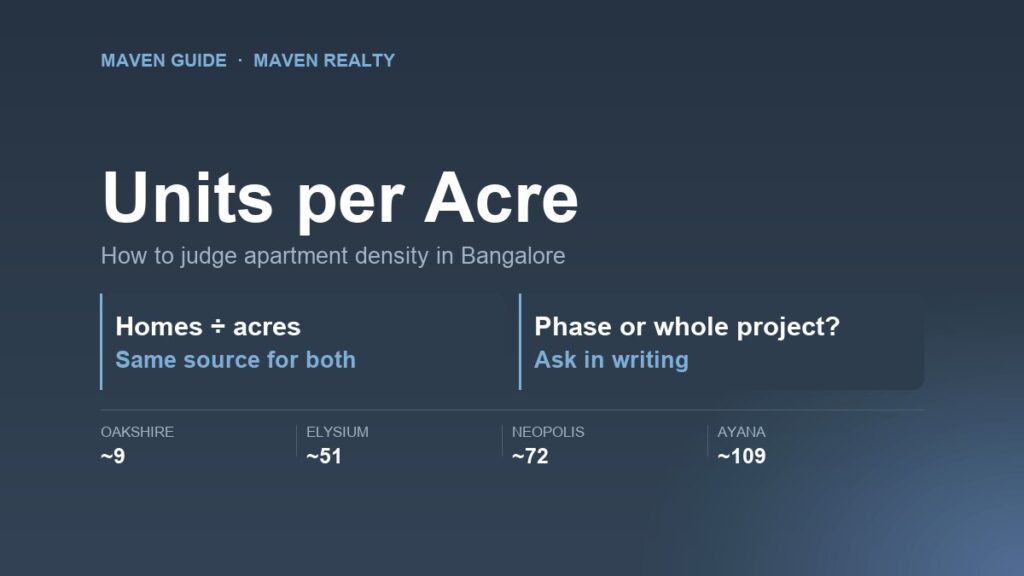
| Sobha Oakshire (row houses, Devanahalli) | 80 | 8 acres 35 guntas | About 9 |
| Sumadhura Elysium (Panathur) | 752 | 14.78 acres | About 51 |
| Sobha Sentosa (Panathur Main Road) | 533 | 7.5 acres | About 71 |
| Sobha Neopolis (off Panathur Main Road) | 1,875 | 25 acres 35.9 guntas | About 72 |
| Sobha Dream Acres (whole township) | 6,500 | 81 acres | About 80 |
| Sobha Ayana (Dream Acres wings 60–71) | 683 | 6.28 acres | About 109 |
Two things stand out. Sumadhura’s “50 units per acre” checks out: 752 ÷ 14.78 is just under 51. And on the same road, Sobha Ayana packs roughly twice as many homes onto each acre as Elysium does.
That doesn’t make Ayana a worse buy. Ayana’s residents also share Dream Acres’ wider grounds and clubhouses, so its own 6.28 acres isn’t the whole picture. Our Sumadhura Elysium vs Sobha Ayana comparison weighs that trade-off.
The row-house figure is there for scale. Nine homes an acre is a different way of living from 50 or 100, and the price reflects it.
Where the Number Misleads
Phase land vs whole-project land
This is the most common trap. A builder may quote the homes in one phase against the land of the whole project, which makes density look lower than it’ll be once every phase is built. Sumadhura Elysium’s RERA registration covers Phase-I only, while its brochure marks an “upcoming phase” and “future development”. Ask whether 752 is the final count for all 14.78 acres.
Township inside a township
Ayana sits inside Dream Acres. Its own number is high, but the township’s is lower. Work out both, and ask which facilities you actually share with whom. Our guide on choosing a flat in a township goes into that.
Density isn’t open space
A project of tall towers can be dense and still leave most of its ground open. A project of low blocks can be less dense but cover more ground. Elysium, for instance, claims 80% open green. That’s a separate number with its own catches, covered in our post on open space percentage.
Flat size changes the feel
Fifty large 4 BHKs per acre house more people than fifty 2 BHKs. When projects mix sizes, density by homes is only a rough guide to how crowded a place will feel.
Marketing rounds in its own favour
“Low density” has no fixed meaning. Don’t take the label; do the division.
Using It to Decide
Density won’t pick a home for you, but it narrows the choice. Use this sheet when you compare two shortlisted projects.
| Check | What to ask or do |
|---|---|
| Units per acre | Homes ÷ acres, from the same source |
| Phase or whole? | Is the home count final for all the land? |
| Flats per lift | Number of flats served by each lift |
| Clubhouse per home | Clubhouse sq ft ÷ homes that share it |
| Gates and driveways | Number of entry and exit points |
| Water and backup | How the plant and generators are sized |
| Resale competition | How many identical flats are in the project |
If you value quiet, short lift waits and an uncrowded pool, give density a lot of weight. If you care more about price and a lively community with plenty of facilities, a denser project can still be the right call. There’s no correct number, only the one that suits how you live.
Before you book anywhere, visit a finished project by the same builder at a busy hour. Our guide to visiting a developer’s completed project lists what to watch.
FAQs
How do I calculate units per acre?
Divide the total number of homes by the total land in acres. Convert guntas first: 40 guntas make one acre. Use both numbers from the same source.
What is a good units per acre figure?
There’s no official benchmark. Compare projects you’re actually considering. On Panathur Road, the projects we checked range from about 51 to about 109.
Is Sumadhura Elysium really 50 units per acre?
Its figures, 752 homes on 14.78 acres, work out to just under 51. Ask whether 752 is the final count across all phases.
Is density the same as open space?
No. Density counts homes per acre. Open space measures how much ground isn’t built on. A project can score well on one and badly on the other.
Does high density mean a bad project?
Not by itself. It means more people share the same facilities. Check how lifts, gates, clubhouse and water are sized for that number.
Where do I find the number of units?
In the brochure, the builder’s FAQ or the RERA filing. If the builder won’t give it, treat that as a warning sign.
Sources we checked (28 October 2026): Sumadhura’s Elysium page, brochure and RERA certificate; Sobha’s pages for Oakshire, Sentosa, Neopolis, Dream Acres and Ayana. Every units per acre figure is our arithmetic from the builders’ own home counts and land areas.
General information, not advice. Builders’ home counts and land areas can change between phases; check the current RERA filing.
Comparing two projects? Talk to us
We’ll work out density, clubhouse share and flats per lift for your shortlist.