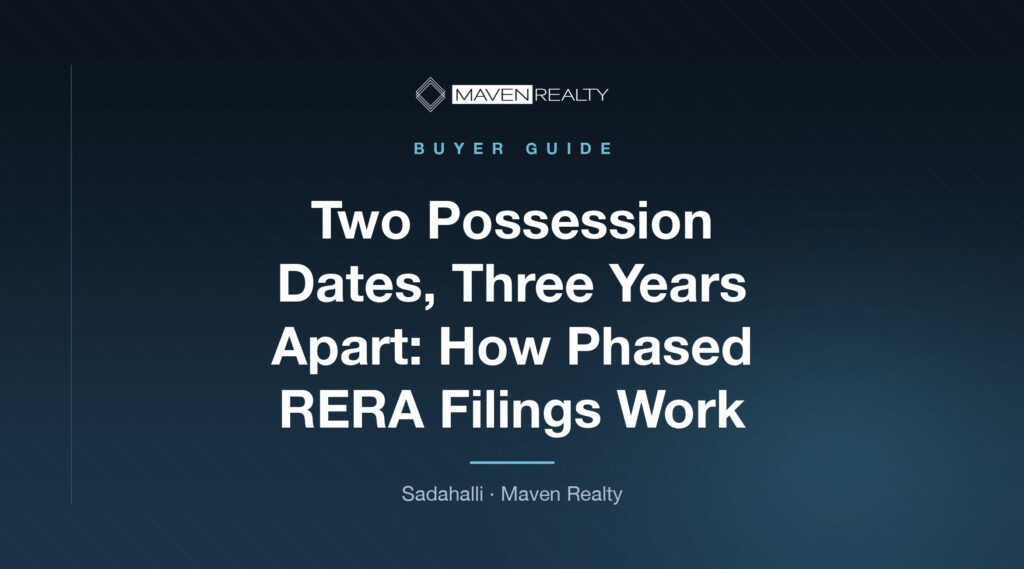
You will sometimes find two possession dates for the same project, years apart, both confidently published. Lodha Beaumont Estate currently has December 2027 and December 2030 in circulation — a three-year gap. This is not a typo and it is not necessarily anyone lying. Here is how it happens and which date actually binds.
Key takeaways
- Only the date in the RERA filing for your phase has legal consequences.
- Brochure and sales dates are targets. They carry no penalty if missed.
- On a phased project, each phase files separately with its own date — hence multiple dates.
- A date quoted before registration is complete is an intention, nothing more.
- Ask for the declared completion date on your phase filing, in writing, and verify it yourself.
The live example: Lodha Beaumont Estate — December 2027 and December 2030 both reported, on a project whose Cluster 1 registration number we could not locate. Our full position is on the listing page.
Three different dates, three different meanings
Most confusion here comes from treating all possession dates as the same kind of statement. They are not.
| Date type | What it is | Binding? |
|---|---|---|
| Developer target | The internal construction plan | No |
| Marketing date | What appears in brochures and listings | No |
| RERA declared completion | Filed with the authority per phase | Yes |
The third one is the only date with teeth. Under the RERA framework, a developer who misses the declared completion date owes the buyer interest on money paid, and the buyer has a withdrawal right.
Developers therefore file conservative dates and market optimistic ones. A three-year gap between the two is unusual but not inexplicable.
There is a fourth date you will sometimes hear, which is the fit-out or handover date. That is when you can start interiors, and it can sit months ahead of the occupancy certificate. Do not confuse the two — you cannot legally move in before the certificate is issued.
So when someone quotes you a possession date, the first question is which of these four they mean. Half the confusion in this conversation dissolves at that question.
Why phased projects produce several dates at once
A large estate is not registered once. Each phase or cluster gets its own registration, its own sanctioned plan and its own declared completion date.
So a 70-acre estate planned to reach 104 acres might carry four or five live registrations at different stages, with completion dates spread across a decade. All of them are genuine dates for that project.
What goes wrong is when a listing site or a sales conversation collapses them into one figure. The earliest date gets quoted because it sounds better, and it may belong to a cluster you are not buying in.
This is the same problem as estate-versus-cluster acreage, and it has the same fix. Ask which phase, then ask for that phase’s filing.
The specific case where a date means nothing yet
If a project’s registration is still pending, any completion date attached to it is an intention. There is no filing for it to be declared in.
Beaumont Estate illustrates this cleanly. Cluster 1 is widely reported as RERA-approved, but we could not find the registration number published anywhere. Until that number exists and can be read, neither December 2027 nor December 2030 is a declared date.
That is not a reason to write the project off. Pre-launch buying has real advantages on price and unit choice. It is a reason not to plan a move, a school admission or the end of a rental agreement around either figure.
Our advice is blunt: if you need a home by a specific month, do not buy a project whose registration is pending, whatever date you are quoted.
How to check a date yourself in ten minutes
You do not need a lawyer for this, and you should not take the developer’s word for it.
- Ask which phase or cluster your unit belongs to, by name and number.
- Ask for that phase’s RERA registration number. If the answer is vague, stop there.
- Search that number on the Karnataka RERA portal yourself.
- Read the declared completion date in the filing, not the brochure.
- Compare it to what you were told verbally, and ask about any gap.
A developer with nothing to hide will hand over the number without hesitation. Reluctance at step two is the most useful signal you will get in the whole process.
While you are on the portal, read two more things. The quarterly progress updates show what has actually been built against what was promised, and the complaints section shows whether buyers on the developer’s other projects have filed against them.
Both are public, both take minutes, and between them they tell you more about delivery risk than any amount of brand reputation does.
What happens if the declared date is missed
The RERA framework gives you two routes, and it is worth knowing them before you need them.
You can continue with the purchase and claim interest on the amount you have paid, for every month of delay past the declared date. Or you can withdraw and claim a refund with interest.
Both routes depend entirely on there being a declared date to have missed. This is the practical reason the filing matters more than the brochure: it is what converts a delay from a disappointment into a claim.
In practice, most buyers on delayed projects negotiate rather than litigate, and a documented declared date is what gives that negotiation force. Keep the filing, the allotment letter and every payment receipt.
One practical point on home loans. If you are on a construction-linked plan, your EMI starts before possession and you may be paying rent alongside it. A three-year swing in the completion date is therefore a three-year swing in the cost of carrying the purchase, not just an inconvenience.
Work that number out on both dates before you commit. Rent plus interest across thirty-six extra months is usually large enough to change which project makes sense.
Common questions
Which possession date is legally binding?
The declared completion date in the RERA filing for your specific phase. Brochure dates, website dates and verbal assurances carry no penalty if missed. If a project has several phases, each has its own declared date.
Why does Lodha Beaumont Estate have two possession dates?
December 2027 and December 2030 are both reported, three years apart. Since we could not locate a published registration number for Cluster 1, neither figure is currently a declared RERA date. Ask for the filing and read the date in it.
What can I claim if possession is delayed?
Under the RERA framework you can either continue and claim interest on amounts paid for each month of delay past the declared date, or withdraw and claim a refund with interest. Both depend on there being a declared date in a filing.
Can a developer change the declared completion date?
Extensions are possible through the authority in defined circumstances, and they are recorded. That is another reason to check the filing directly rather than relying on a date quoted to you earlier, as the current filing shows any revision.
Should I buy a project whose RERA registration is pending?
It can make sense for price and unit choice, but not if you need a home by a particular month. With registration pending there is no declared date, so any timeline you are given is an intention rather than an enforceable commitment.
Want the real date on your project?
Send us the project and phase and we will pull the RERA filing, read the declared completion date out of it, and tell you how it compares with what you were told. Takes us a day. No charge.
Related reading
This is general information on how declared completion dates work, not legal advice on any specific agreement. Figures above are drawn from published project information and are indicative. Where sources conflicted we have stated both positions rather than picking one. Verify any registration yourself on the Karnataka RERA portal before paying a booking amount.