“Villament” turns up in Bangalore ads all the time, and most buyers aren’t sure what they’d actually own. Here’s the villament meaning in plain words, how a villament differs from a villa, a row house and an apartment, and the five questions that tell you whether a particular one is worth the money.
Key takeaways
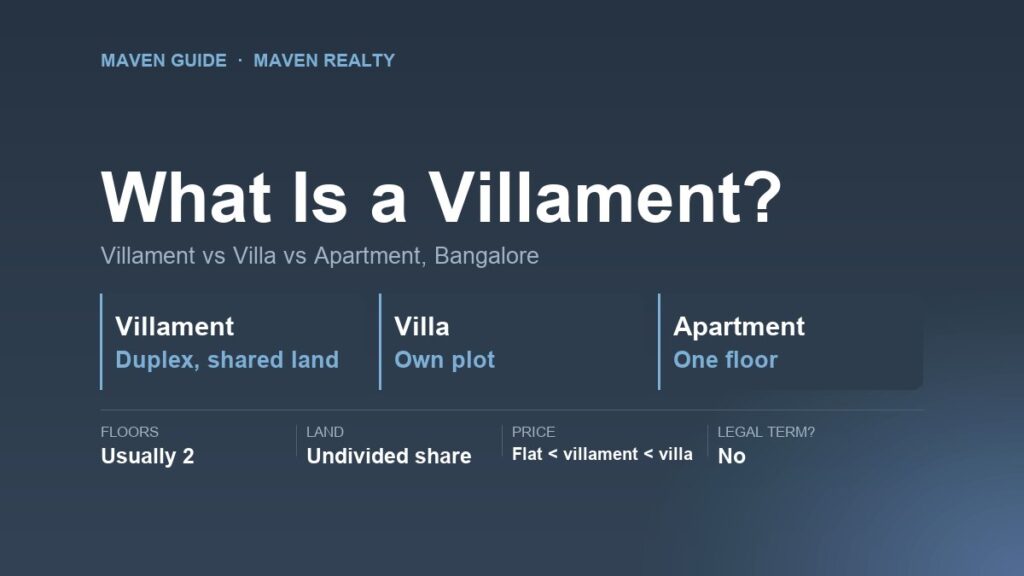
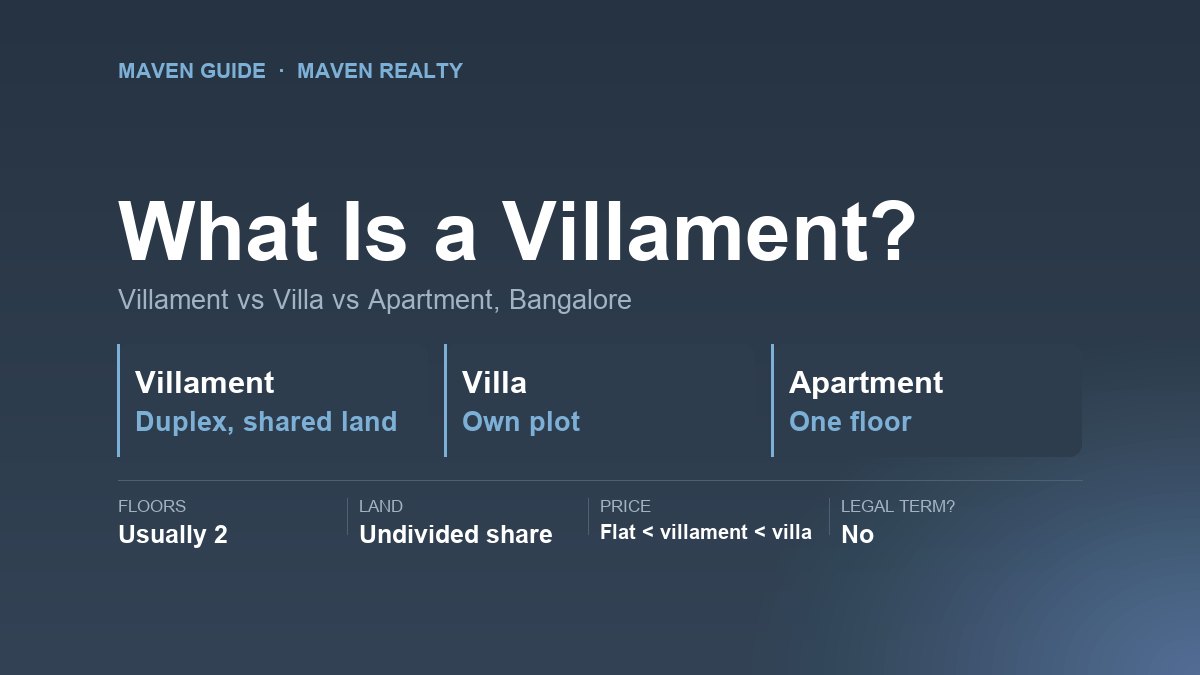
- A villament is a low-rise home, usually a duplex, stacked or set in small blocks, with shared amenities like an apartment complex
- Shriram, which has built them in Bangalore, calls a villament “a fusion of a villa and an apartment”
- You usually own an undivided share of the land, not your own plot, which is the big difference from a villa
- Villaments typically sit between apartments and villas on price
- “Villament” isn’t a legal category, so read the sale deed and the RERA filing, not the brochure label
Looking at a specific project? Our Shriram Villaments Bannerghatta Road page covers Shriram’s upcoming 5-acre villament plan, the expected price and the RERA status.
In this guide
Villament Meaning, in Plain Words
A villament is a home that tries to give you villa-style space without villa-style land. The word is a blend of “villa” and “apartment”, and that’s roughly what it is.
In practice, a villament is usually a duplex: two floors of your own, often with a private terrace or a small garden. But instead of standing alone on a plot, it sits in a low-rise block with other homes above, below or beside it. The whole community shares a clubhouse, security, landscaping and roads, just like an apartment complex.
Shriram Properties, which has built villaments in Bangalore, described them on its own blog in 2016 as “a fusion of a villa and an apartment”. The same post said villament communities “generally spread over a wide area of 5–7 acres” and that villaments are “comparatively expensive than the apartments but… cheaper than the villas”.
That’s the short villament meaning, and it’s the one most builders work to. The longer answer depends on how a particular builder has drawn it, because there’s no fixed design.
Villament vs Villa vs Row House vs Apartment
The villament meaning gets clearer next to the alternatives. The four get mixed up in ads. Here’s how they usually differ. Every project is different, so treat this as a starting point and check the actual plans.
| Villament | Villa | Row house | Apartment | |
|---|---|---|---|---|
| Land | Undivided share of the whole site | Your own plot, usually | Small plot or land share | Undivided share of the whole site |
| Homes above or below you | Often yes | No | No | Yes |
| Walls shared | Yes | No (detached) | Both sides, usually | Yes |
| Floors of your own | Usually two (duplex) | Two or three | Two or three | One |
| Private terrace or garden | Often | Yes | Small, usually | Rarely |
| Height of the building | Low-rise | Low-rise | Low-rise | Any, often high-rise |
| Shared amenities | Yes | Yes, in a gated community | Yes, in a gated community | Yes |
| Typical price | Between flats and villas | Highest | Between villament and villa | Lowest per home |
The simplest way to put the villament vs villa question: a villa is a house, and a villament is a very large flat that feels like a house. A row house sits in between.
What You Actually Own in a Villament
This is the part brochures skip. In most villament projects, you don’t get a plot with your name on it. You get your home plus an undivided share of the land the whole project stands on, usually called the UDS. That’s how apartments work too.
Why does it matter? Three reasons.
First, you can’t knock down and rebuild your villament the way a villa owner might rebuild a house. The building belongs to everyone in the block.
Second, the land share drives long-term value. Ask for your UDS in square feet. On a 5-acre villament site the share per home is far bigger than in a 40-floor tower, and that’s a real part of what you’re paying for.
Third, the private terrace or garden may not be yours outright. Sometimes it’s an “exclusive use” area attached to your home, sometimes it’s sold as part of the saleable area, and sometimes it’s common area you’re simply allowed to use. Those are very different things.
One more point on villament meaning: “villament” isn’t a legal category under RERA or the municipal rules. It’s a marketing word. What counts is what’s written in the agreement for sale, the sale deed and the RERA filing.
A Real Example: Shriram’s Villaments
Shriram Chirping Woods in Harlur, off Sarjapur Road, is one of the better-known villament projects in Bangalore. Shriram describes it as a 15-acre community of villaments and apartments, with the villaments registered separately on Karnataka RERA (PRM/KA/RERA/1251/446/PR/171014/001085).
Shriram’s 2018 blog put its 4 BHK villaments there at 2,650 to 3,600 sq ft, with double-height living rooms. That’s the scale to expect: bigger than most 3 BHK flats, smaller than most standalone villas.
The same blog also ran a 2018 promotion with a small booking amount and a subsidised interest rate. Offers like that come and go. Read what they actually cost the builder and what they cost you before you let one decide your purchase.
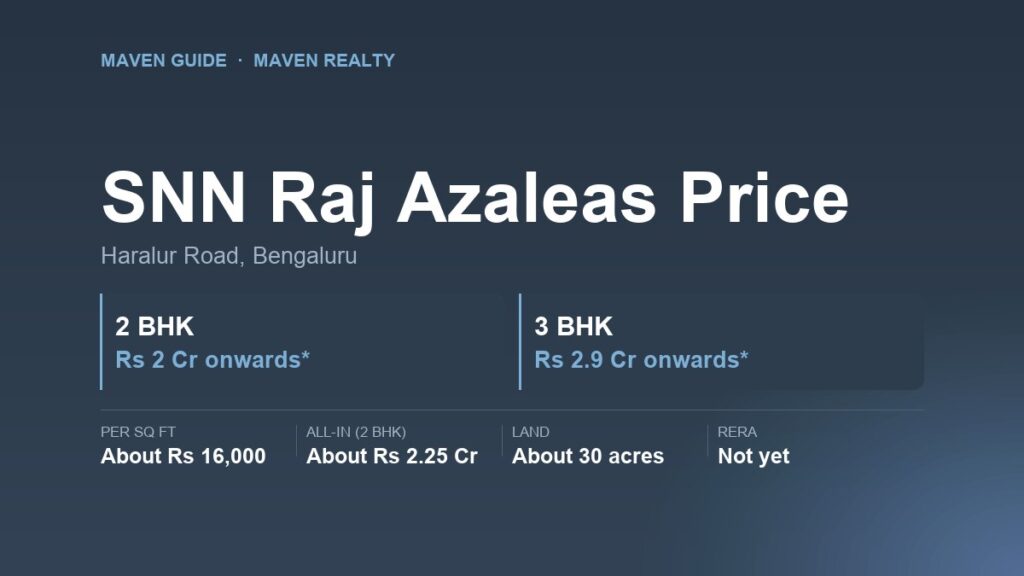
Shriram is now planning a new villament community on about 5 acres of Bannerghatta Road, expected to start around ₹2.9 Cr*. It isn’t RERA-registered yet.
*Expected price, excluding GST, stamp duty and registration. Ask us for the latest cost sheet for a named unit before you pay a booking amount.
The Costs People Miss
Villaments look like good value per square foot next to villas. Some of that is real. Some of it shows up later.
Maintenance. You’re paying for shared amenities across fewer homes than a tower, so the bill per home can be higher than you’d guess. Ask whether it’s charged on saleable area, and whether the private terrace counts.
Stairs. A duplex means stairs inside your home. Ask whether there’s provision for a home lift if you might need one later.
Resale. There are fewer comparable sales to price a villament against than a standard flat. That’s the honest downside. When you sell, the buyer pool is smaller and the price is harder to benchmark.
Car parks. Some villaments have a car park at the door, some in a shared basement. Check which, and how many.
Five Questions to Ask Before You Buy a Villament
- What’s my undivided share of land, in sq ft? Get it in writing.
- Is the terrace or garden mine, exclusive-use or common? And is it in the saleable area?
- Who lives above or below me? Ask for the block section drawing.
- How is maintenance calculated? Per sq ft of what, exactly?
- What does RERA call it? Look up the registration and read the unit type and carpet area there.
If a builder can’t answer the first two clearly, you’re not buying a villament yet. You’re buying a label.
FAQs
What is the meaning of villament?
A villament is a low-rise home, usually a duplex, built in small blocks with shared amenities. It combines villa-style space with apartment-style ownership and upkeep.
What is the difference between a villament and a villa?
A villa usually stands on its own plot with no homes above or below it. A villament shares walls, often has homes above or below, and you normally own an undivided share of the land rather than a plot.
Is a villament better than an apartment?
It gives you more space, two floors and often a private terrace, with a much bigger land share. The trade-off is a higher price, higher upkeep per home and fewer comparable resale deals.
Are villaments cheaper than villas?
Usually, yes. Shriram’s own description puts villaments above apartments but below villas on price.
Is villament a legal property type?
No. It’s a marketing term. Check the agreement for sale, the sale deed and the RERA registration to see what you actually own.
What we checked (4 November 2026): Shriram Properties’ own blog posts on villaments (December 2016 and May 2018), its Shriram Chirping Woods project page and its 3 November 2025 stock-exchange press release on the Bannerghatta Road villament plan.
The comparison table describes how these home types usually differ in Bangalore. Individual projects vary, so check the actual plans and RERA filing.
General information, not legal or financial advice. Prices are indicative and can change; get a written cost sheet before you pay anything.
Weighing a villament? Talk to us
We’ll get you the RERA carpet area, the land share and a written cost sheet for a named home.