An e-Khata sample is the first thing most Bengaluru property owners go looking for, and usually for a practical reason — something has arrived, or is about to, and you want to know whether it is the real document. This page shows you an actual e-Khata certificate from Bengaluru, walks through every field on it, and explains how to tell a draft apart from a final one before it costs you a transaction.
Key takeaways
- An e-Khata certificate is a single digital page carrying owner name, property dimensions, assessment number and tax status.
- The status field is the first thing to read. Draft and final are different documents and only one of them is accepted.
- It is not a title deed and says nothing about whether ownership is clean.
- Owner name must match your sale deed character for character. This is the most common defect.
- Download it only from e-Aasthi. A PDF someone WhatsApps you is not verification.
Checking a certificate before you buy? Send us the address and we will read the record with you, including the parts a seller would rather skip. Free, on any property — including ones on our Bengaluru listings.
What an e-Khata certificate looks like
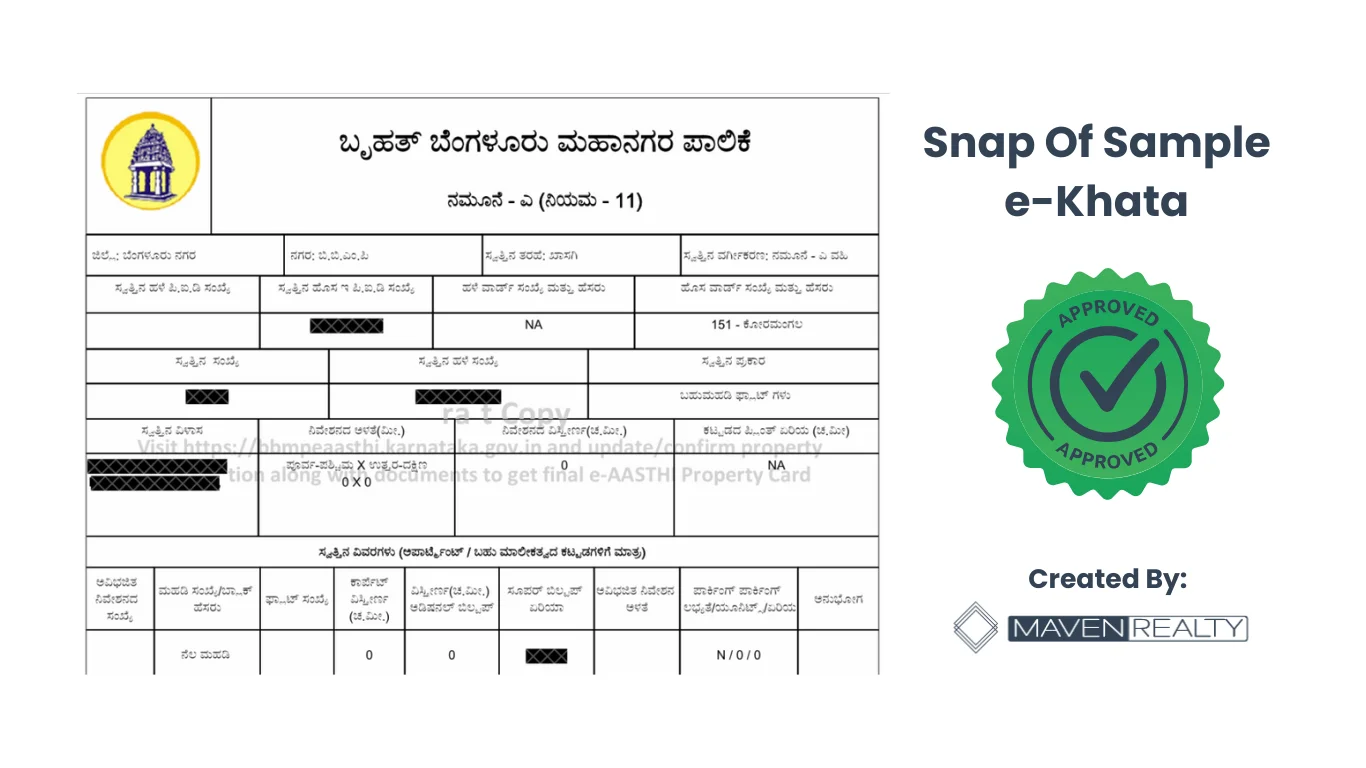
Here is a real one. This is a sample e-Khata certificate issued for a Bengaluru property, with the owner’s details being the only thing you would expect to differ on yours.

It is one page. That surprises people who are used to the old paper Khata extract and its attachments. Everything that matters sits in a small block of fields near the top, and the rest is formatting.
What you are looking at is a civic record, generated from the municipal property database and signed digitally. It exists to answer one question: who is on record as responsible for this property, and is their tax paid? Every field on it serves that question, which is why the document is short.
The anatomy of the certificate, field by field
Read it in this order. The sequence matters, because a problem in field one makes fields four and five irrelevant.
Status. Somewhere near the top the certificate declares itself draft or final. A draft is the system showing you what it already believes about your property. A final is issued after an officer has checked your documents. Banks and sub-registrars accept only the final.
Owner name. Compare it letter by letter against your sale deed. An initial where the deed spells a name in full, or a surname recorded before marriage, is enough to stall a registration months later.
Assessment or SAS property tax number. This ties the certificate to an actual tax record. If it is blank, or does not match the receipts you hold, the certificate is describing a different property from the one you think you are looking at.
Dimensions. These should reflect the approved plan, not what was built. Where a previous owner enclosed a balcony or added a floor, the numbers diverge, and that divergence is visible here before it becomes your problem.
Tax status. Arrears do not just sit there quietly. They block the sale.
Draft e-Khata versus final e-Khata
This is the distinction that causes the most expensive mistakes, and the two documents look similar enough at a glance that people miss it.
| Draft e-Khata | Final e-Khata | |
|---|---|---|
| How it appears | Generated automatically from existing records | Issued after you apply and are verified |
| Officer verification | None | Yes, sometimes with a site visit |
| Accepted by a bank | No | Yes |
| Accepted at registration | No | Yes |
| What it is good for | Checking your own details for errors | Everything |
The draft has one genuine use and it is a good one: it shows you what the municipal record says before you commit to an application. Read it, find the errors, fix the underlying records, then apply. That order saves a rejection.
If a seller shows you a draft and says the final is “in process”, that is not a document. It is a pending approval you are being asked to treat as a certainty. Ask when it was applied for and what the portal says the current stage is — both are checkable, and a straight answer takes thirty seconds.

What the certificate does not tell you
This matters more than anything the document does say, because people routinely over-read it.
A Khata is a civic record of who pays tax on a property. It is not a title document. It carries no statement that ownership is clean, that no litigation is pending, that no bank holds a charge, or that the construction is legal. A property can hold a perfectly valid e-Khata and still be the subject of a family dispute you would very much want to know about.
What actually establishes ownership is the chain of sale deeds, and what surfaces encumbrances is the encumbrance certificate. The e-Khata sits alongside those two, confirming the municipal body recognises the current owner for tax purposes. Treat it as one of three documents rather than as the answer.
There is a second limit worth naming. An e-Khata does not upgrade a B-Khata property into an A-Khata one. It digitises whatever status the property already holds, irregularities included. If the underlying property has a deviation from the approved plan or sits on converted revenue land, it still does after the certificate arrives.
Where the e-Khata sits among your other documents
Property paperwork in Bengaluru confuses people because four different documents each answer a different question, and none of them answers all four. Here is the division of labour.
| Document | The question it answers | Who issues it |
|---|---|---|
| Sale deed | Who owns this property? | Sub-registrar, Department of Stamps and Registration |
| Encumbrance certificate | Is there a loan, lien or dispute registered against it? | Sub-registrar |
| e-Khata | Who does the civic body hold responsible for tax, and is it paid? | Karnataka Municipal Data Society, via e-Aasthi |
| Occupancy certificate | Is the building legally fit to live in? | The city corporation |
A buyer who collects only the e-Khata has confirmed the tax position and nothing else. A buyer who collects only the sale deed knows who owns it but not whether four years of property tax are outstanding, which becomes their bill on transfer. The documents are complements, not alternatives, and any seller reluctant to produce all four is telling you something.
One more piece of context worth knowing in 2026. The authority behind the civic half of this changed recently — the Greater Bengaluru Authority replaced BBMP on 2 September 2025, and the city is now organised as five corporations rather than one. Your certificate, your property tax ID and the portal all carried across unchanged, so an older e-Khata is not invalidated by the switch. What changed is whose name sits on newly issued certificates and which office handles a dispute.
How to get a genuine copy
Only one channel produces a real certificate: e-Aasthi, the Urban Property Management System run by the Government of Karnataka through the Karnataka Municipal Data Society. There is no agent with faster access, because there is no second door.
- Already have one on record? Try pulling it down directly using your SAS property tax ID. If your details are clean in the system, it takes minutes and you skip the application entirely.
- Applying fresh? The full process, documents and the fields that trip people up are in our guide to applying for an e-Khata in Bangalore.
- Verifying someone else’s? Ask the owner to download it in front of you from the portal. A forwarded PDF proves nothing about what the record currently says.
That last point is the one buyers skip. A certificate downloaded in October tells you about October. If the seller has since fallen behind on tax, the document in your inbox will not mention it.
Stuck? KMDS runs a helpline for e-Khata on 7259585959, Monday to Friday, 10:00 am to 5:30 pm, closed 1:30 to 2:30.
The mistakes that show up on certificates
Four defects account for most of what we see, and all four are visible on the face of the document if you know to look.
- Name spelt differently from the deed. Usually an initial, an expanded middle name, or a pre-marriage surname. Fix the tax record first, then reapply — correcting it afterwards is slower.
- Dimensions that do not match the approved plan. Almost always an old construction deviation. This is a building problem wearing paperwork clothing, and no amount of resubmitting resolves it.
- A blank or mismatched assessment number. Means the certificate is not properly tied to a tax record. Do not accept it.
- Tax shown as pending. Clear the arrears before anything else. Every other step stalls behind this one.
What to do with it when you are buying
For a resale or a ready flat, the certificate is a fast, cheap diligence tool, and it is the one most buyers ask for too late. Ask before you pay an advance, not after.
Three checks in five minutes: is it final rather than draft, does the owner name match the seller’s identity document exactly, and is tax status current. Those three answers predict whether a registration will run smoothly better than anything else available to you at that stage. Ready-to-move projects such as Prestige Sunrise Park will normally have this assembled already — ask for the whole file at once rather than chasing documents one at a time.
For an under-construction purchase there is nothing to check yet, because the Khata follows completion and assessment. What you look at instead is the RERA registration, the approved plan, and the statutory costs, which we break down in what buying a plot in Karnataka actually costs.
Common questions
What does an e-Khata look like?
A single digital page carrying the owner’s name, the property’s dimensions and location, the assessment or SAS property tax number, the property tax status, and a field declaring whether it is a draft or a final certificate. A real Bengaluru sample is shown above.
How can I get an e-Khata sample copy?
Download your own from the e-Aasthi portal at eaasthi.karnataka.gov.in using your SAS property tax ID. For reference only, the images on this page are genuine Bengaluru certificates with the identifying details being the part that differs on yours.
How do I tell a final e-Khata from a draft?
The certificate states which it is. A draft is generated automatically from existing municipal records and carries no officer verification. A final is issued only after you apply and your documents are checked. Banks and sub-registrars accept only the final.
Is an e-Khata proof of ownership?
No. It is a civic record showing who the municipal body holds responsible for property tax. Ownership is established by the chain of sale deeds, and encumbrances appear on the encumbrance certificate. Read all three together.
Does an e-Khata convert a B-Khata into an A-Khata?
No. It digitises whatever status the property already holds. A B-Khata property with an e-Khata is still a B-Khata property, with the same underlying irregularity.
Can I trust an e-Khata PDF a seller sends me?
Not on its own. A certificate reflects the record on the day it was downloaded, and tax status can change after. Ask the owner to pull it live from the portal while you are present.
Related reading
- Occupancy certificate vs completion certificate explained
- e-Khata rejected? What each reason means and how to clear it
- What stamp duty and registration actually cost in Bangalore
- A-Khata, B-Khata and e-Khata: which one do you actually have?
- How to apply for an e-Khata in Bangalore: the 2026 process
- What buying a plot in Karnataka actually costs
- Prestige Sunrise Park, Electronic City: ready to move
Want us to read a certificate with you?
Send us the e-Khata and the address. We will tell you what it actually says, what it leaves out, and whether anything on it would stall a registration. No charge, and no obligation to buy through us.