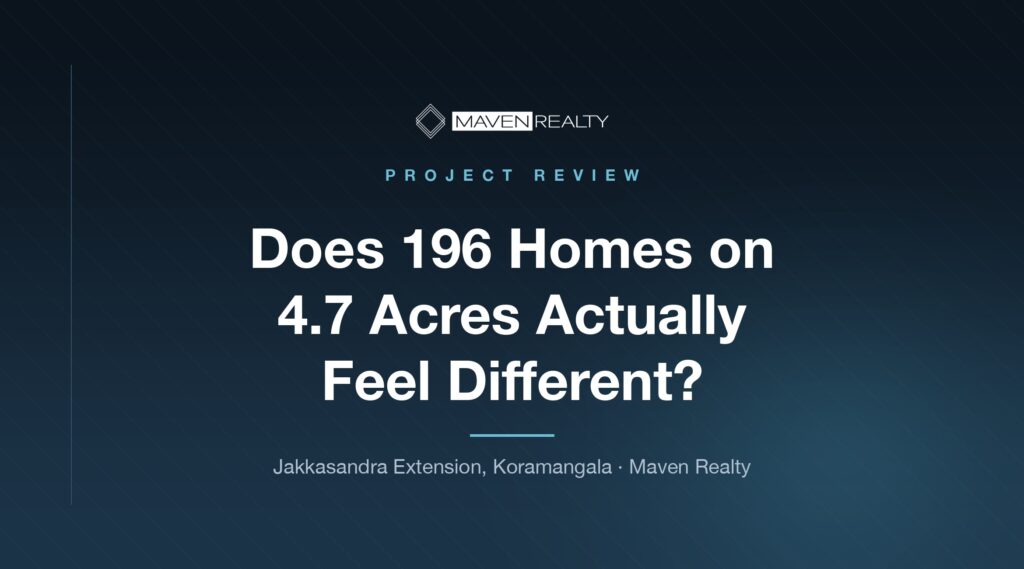
196 homes on 4.708 acres is about 42 an acre. Most Bengaluru towers in this price band run 80 to 150. That gap is the strongest argument Infinia has at its rate — and it shows up in things you notice daily, not on a brochure.
Key takeaways
- 196 homes across 4.708 acres is roughly 42 an acre, our arithmetic
- Comparable towers commonly run 80 to 150 homes an acre
- Density decides lift waits, ramp queues and whether the pool is usable
- Sobha publishes the two inputs but not the result
- Ask for homes per lift core, not just homes per acre
Full project page, every figure sourced to Sobha: Sobha Infinia, Koramangala — 196 homes on 4.7 acres.
The arithmetic, and why Sobha does not do it for you
Sobha publishes two numbers on the Infinia page: 4.708 acres and 196 apartments. Divide one by the other and you get about 41.6 homes an acre.
Developers rarely publish density directly, partly because there is no standard way to present it and partly because for most projects it is not a flattering number. When a project has a good density figure, the inputs are usually published and the division is left to you. When it does not, one of the two inputs tends to go missing.
For reference, a typical Bengaluru high-rise at this price point runs 80 to 150 homes an acre, and value-segment towers can exceed 200. Infinia is at roughly half the lower end of that range. On a 4.7-acre site in a postcode where land costs what Koramangala land costs, choosing to build 196 homes rather than 400 is a deliberate and expensive decision.
What low density actually changes
Density is not an abstraction. It is the difference between a building that works and one that irritates you every morning.
Lifts. The single most common complaint in dense Bengaluru towers is waiting four or five minutes at 8.45am. Fewer homes per core means shorter waits, and it is worth asking directly how many homes share each lift bank rather than relying on the per-acre figure. Our note on the homes per lift core ratio explains why that number beats density as a predictor.
The ramp. At peak, the basement exit is a queue. Half the homes means roughly half the cars trying to leave in the same twenty minutes.
Amenities. A pool shared by 196 households behaves completely differently from the same pool shared by 600. The list of amenities matters far less than the ratio of people to them, which is almost never advertised.
Where the trade-off sits
Low density is not free and you are paying for it in the rate.
The developer has the same land cost whether 196 or 400 homes go on it. Spreading that cost across fewer units is a large part of why Infinia’s entry price works out near ₹24,300 a square foot. A denser project on the same plot could sell at a materially lower rate per square foot and still make the same return.
So the honest question is not whether low density is nicer — it obviously is — but whether it is worth the premium to you specifically. If you work from home and will use the building all day, it probably is. If you leave at 8am and return at 9pm, you will experience the lift and the ramp twice a day and little else, and the calculation is tighter.
The numbers to ask for instead
Homes per acre is a blunt instrument. Four better questions:
How many homes share each lift core, and how many lifts per core? Thirty homes on two lifts behaves well. Sixty on two does not, whatever the site density says.
How many car parks per home, and how many visitor bays in total? In Koramangala, street parking is not a fallback. If visitor parking is thin, your guests have nowhere to go.
What is the ground coverage? The proportion of the site under building versus open. Two projects can share a density figure and feel completely different depending on whether the open space is usable landscape or a driveway.
How many homes per amenity? One pool for 196 is generous. One gym for 196 is adequate. Ask, because a low-density project can still under-provide.
How to test it rather than take it on trust
Sobha has completed buildings across Bengaluru. Go and stand in one at 8.45 on a weekday morning.
Time the lift. Watch the basement ramp. Count how many people are waiting. You will learn more in twenty minutes than from any brochure, and you will calibrate what a given density actually feels like — which is the thing nobody can tell you in the abstract.
Then do the same at a dense tower in the same price bracket. The contrast is usually obvious, and after seeing both you will know whether the premium is worth it to you. Buyers who do this either become convinced low density is worth paying for, or decide it is not and buy more square footage elsewhere. Both are reasonable. Deciding without looking is not.
What density does not fix
Worth being clear about the limits, because density gets oversold as a proxy for quality.
It does not fix the road outside. The Sarjapur–Marathahalli stretch is congested regardless of how many homes are inside your gate, and 42 an acre does not shorten your commute by a minute.
It does not fix build quality. A low-density building finished badly is still finished badly, which is why inspecting Sobha’s older completed buildings matters as much as the density arithmetic.
And it does not fix maintenance costs. Fewer homes means the same lifts, pumps, generators and landscaping are paid for by fewer households, so per-home maintenance in a low-density project is often higher than in a dense one. Ask for the projected per-square-foot maintenance charge, and read our piece on how CAM and corpus actually work before you assume low density means cheap running costs.
Common questions
How many homes per acre is Sobha Infinia?
About 42. Sobha publishes 196 apartments on 4.708 acres; the division is ours. Comparable Bengaluru towers in this price band commonly run 80 to 150 homes an acre.
Is low density worth paying extra for?
It depends how much you use the building. Low density shows up in lift waits, basement queues and how crowded amenities feel. If you are home most of the day it matters a lot; if you leave at 8am and return at 9pm you experience it twice daily and little else.
Does low density mean lower maintenance charges?
Usually the opposite. The same lifts, pumps, generators and landscaping are funded by fewer households, so per-home maintenance in a low-density project is often higher. Ask for the projected per-square-foot charge.
What is a better measure than homes per acre?
Homes per lift core. Thirty homes sharing two lifts behaves well; sixty sharing two does not, regardless of site density. Also ask about car parks per home, visitor bays and ground coverage.
How many flats are there in Sobha Infinia?
196 apartments on 4.708 acres, in 3 and 4 BHK configurations sized between 1,768 and 3,264 sq ft, per Sobha’s own project page.
How can I tell what a density will feel like?
Visit a completed building at 8.45am on a weekday. Time the lift, watch the basement ramp, count who is waiting. Then do the same at a dense tower in the same price bracket and compare.
Looking at Infinia?
We are channel partners, not brokers. We will get you the RERA carpet area, tell you which wing your unit sits in, and say plainly when a resale flat would serve you better.
Related reading
Figures from Sobha’s own project page, read 3 October 2026, and from Karnataka RERA filings. Statutory rates verified 3 October 2026 and subject to change. Nothing here is an offer or a contract — verify any registration number on the Karnataka RERA portal.