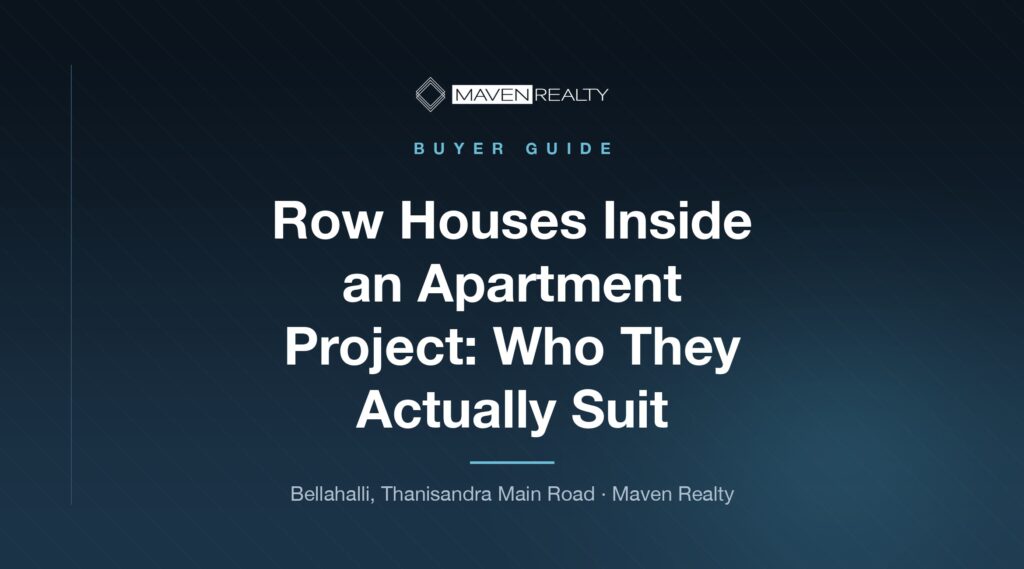
A handful of row houses tucked inside a high-rise project is an odd product on paper. Nikoo Homes 8 reportedly has 24 or so alongside six apartment towers. They suit a very particular buyer extremely well and everyone else badly, and the difference comes down to what you are sharing and what you are not.
Key takeaways
- A row house gives you your own front door and no lift, inside a gated project.
- You still pay project maintenance, usually on a larger built-up area.
- Privacy is better; noise from neighbours is different, not absent.
- They are scarce, which helps resale but thins the comparable set.
- Check whether you get any private outdoor space, and whether it is yours or common.
Where this comes up: Nikoo Homes 8 — a reported low-rise cluster of 24 or more row houses beside six towers. Configuration detail on the listing page.
What you are actually buying
A row house in an apartment project is a low-rise home in a terrace, sharing side walls with its neighbours, inside the same gate and the same association as the towers.
The appeal is structural rather than decorative. You get your own entrance at ground level, no lift, no shared corridor, and usually a vertical layout across two or three floors.
What you do not get is a villa. There is no land around the house on all sides, no independent compound, and usually no separate title to a plot — you are typically buying built-up area within the project, as apartment buyers are.
That last point catches people. Ask specifically what you are acquiring: undivided share in land plus a constructed house, or something else. The answer affects everything from loan treatment to resale.
It also affects what you may alter later. A row house inside a project is governed by association rules and sanctioned plans in much the same way an apartment is.
The facade in particular is usually not yours to change. Terraces in a row are designed as one composition, and associations generally hold owners to it, so an extension or an enclosure that one owner makes tends to become a dispute.
The genuine advantages
Four, and they are real enough to justify the premium for the right household.
No lift dependence. You walk in from the ground. No waiting at 8:45, no problem during a power cut, no inconvenience moving furniture.
Your own door. A private entrance changes how a home feels more than most people expect, and it makes deliveries, staff and visitors far simpler to manage.
Vertical separation. Bedrooms upstairs and living space downstairs gives a household separation an apartment floor plate cannot, which matters with teenagers or working from home.
No one above you. The single most common apartment complaint — footsteps and furniture overhead — simply does not apply.
Together these are why row-house buyers rarely go back to apartments. They are living differences rather than specification differences.
The trade-offs nobody mentions
Equally four, and they are the reasons this format suits a minority.
| Trade-off | What it means in practice |
|---|---|
| Shared side walls | Neighbour noise moves horizontally instead of vertically |
| Stairs | A genuine consideration for ageing or mobility |
| Ground-floor security | More exposed than a tenth-floor flat; check the arrangement |
| Maintenance on larger area | Charged per sq ft, and row houses are usually bigger |
The last row is the one that surprises buyers. Maintenance is levied per square foot across the project, so a larger row house pays more every month than an apartment — often for amenities weighted toward tower residents.
Ask how the association apportions charges between the low-rise cluster and the towers, and whether row houses pay for lift maintenance they will never use. Some projects adjust for this; many do not.
Our guide to CAM, corpus and sinking fund covers how to get the projected rate before you commit.
The outdoor space question
This decides whether a row house is worth its premium, and the answer varies enormously between projects.
Some row houses come with a private front or rear yard, a terrace, or both, demarcated and exclusive to you. That is a genuine garden and it transforms the home.
Others have only a setback strip that is technically common area, which you may plant but not enclose, and which anyone may walk through.
Ask three things: is there private outdoor space, is it exclusive or common, and is it shown as yours on the sanctioned plan. Verbal assurance is not enough here, because the difference is visible on a drawing.
Also ask what you may do with a terrace if you have one. Covering, enclosing or building on a terrace usually needs approval and frequently is not permitted, whatever the previous owner did.
A row house with genuine private outdoor space is a different product from one without, and it should be priced as one.
Resale: scarcity cuts both ways
With perhaps two dozen row houses in a project of a thousand homes, you are in an unusual position at resale.
In your favour: almost no competition. If two buyers want a row house in this project in a given year and only one is for sale, that is a strong position.
Against you: almost no comparables. A valuer looking for recent transactions of the same type in the same project may find none, and will value conservatively, which can constrain your buyer’s loan.
The buyer pool is also narrower. Most people shopping a large apartment project are looking for apartments, so your marketing has to reach a different audience.
On balance this is a format to buy because you want to live in it, not as a trading position. Our guide to the resale problem in small projects covers the valuation mechanics in detail.
Keep good records from day one — the agreement, the sanctioned plan showing your outdoor space, and any interior spend. On a format with no comparables, documentation is what supports your price.
One practical suggestion if you are seriously considering one: find a completed project by the same developer that also has a row-house cluster, and walk it. How those houses look and feel at ten years old will tell you whether the format was designed properly or added to the masterplan late.
Common questions
What is a row house in an apartment project?
A low-rise home in a terrace, sharing side walls with its neighbours, inside the same gate and association as the towers. You get a private ground-level entrance and a vertical layout, but typically not separate plot title or land on all sides.
Is a row house better than an apartment?
For some households, clearly. No lift dependence, your own front door, vertical separation between living and sleeping areas, and nobody above you. Against that: shared side walls, stairs, more exposed ground-floor security and higher maintenance on a larger area.
Do row houses pay the same maintenance as apartments?
Usually the same rate per square foot, which means a higher bill because row houses are larger. Ask how the association apportions charges between the low-rise cluster and the towers, and whether row houses pay toward lift maintenance they never use.
Do row houses come with private outdoor space?
It varies. Some have an exclusive yard or terrace shown on the sanctioned plan; others have only a common-area setback strip you may plant but not enclose. Ask whether it is exclusive and whether it appears as yours on the drawing.
Are row houses hard to resell?
Scarcity cuts both ways. Few competing sellers helps you, but almost no comparable transactions means conservative bank valuations and a narrower buyer pool, since most people shopping a large apartment project want apartments.
Considering a row house in a project?
Send us the floor plan and the sanctioned plan and we will check what outdoor space is actually exclusive to you, how maintenance is apportioned, and what the resale position looks like. No charge.
Related reading
Figures above are drawn from published project information and are indicative. Verify any registration yourself on the Karnataka RERA portal before paying a booking amount.