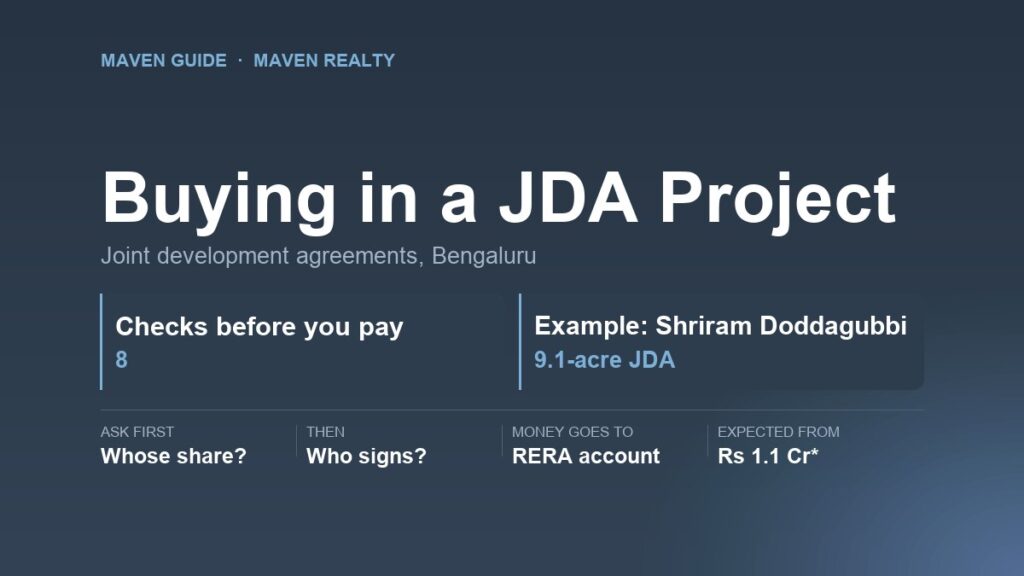
More and more Bengaluru projects are built under a joint development agreement, where a landowner provides the land and a developer builds on it. Shriram’s planned Doddagubbi apartments and its Bannerghatta Road villaments are both joint developments. For a flat buyer, a joint development agreement isn’t a red flag, but it does add questions an outright purchase doesn’t. Here are the eight to ask before you pay.
Key takeaways
- Under a joint development agreement (JDA), the landowner keeps a share of the homes or the sale money, and the developer builds
- Your flat might come from the developer’s share or the landowner’s, and that decides who signs your agreement
- Landowner units can be sold separately, sometimes at a different price
- Check the title, the development rights document and who is named on the RERA registration
- Listed developers such as Shriram use JDAs to keep land costs down; that’s a business choice, not a warning sign
Looking at a JDA project now? Our Shriram Properties Doddagubbi page covers a 9.1-acre joint development planned for early 2027.
In this guide
What a Joint Development Agreement Is
In a joint development agreement, two parties pool what they have. The landowner brings the land. The developer brings the money to build, the approvals and the selling. Neither pays the other the full value up front.
The split comes in one of two ways. In an area share, the landowner gets a fixed number of finished flats, say 35 or 40% of the built-up area. In a revenue share, the landowner gets a percentage of the sale money instead. Some deals mix both.
The alternative is an outright purchase, where the developer buys the land and owns the whole project. Shriram’s Sarjapur Road project, for example, is on land Shriram says it bought outright in February 2026. Its Doddagubbi site, announced in June 2026, is a JDA.
Why Developers Use Joint Development Agreements
Land is the biggest single cost in a Bengaluru project. Buying 9 acres outright ties up hundreds of crores before a single flat is sold. A JDA lets the developer start with far less money in the ground. Shriram describes this as its “asset-light” approach, and many listed developers do the same.
For the landowner, the deal turns land into flats or a share of sales, usually worth more than a straight sale. For you, it mostly doesn’t matter, as long as the paperwork is clean. That “as long as” is the whole point of this guide.
8 Things to Check in a Joint Development Agreement Project
1. Whose share is your flat in?
In any joint development agreement project, ask directly: is this unit in the developer’s share or the landowner’s? The answer decides who you’re buying from, who signs your sale agreement and who you’d chase if something goes wrong. Get it written on the booking form.
2. Who signs the agreement for sale?
In a developer-share flat, the developer usually signs. In a landowner-share flat, it might be the landowner, or the developer acting under a power of attorney from the landowner. Either can be fine. What isn’t fine is nobody being able to show you the document that gives them the right to sign.
3. Is the development rights document registered?
The joint development agreement itself, and any power of attorney that goes with it, should be registered documents. Ask for copies, or at least the registration numbers and dates. Then have a lawyer check that they cover your survey numbers and give the signatory the power to sell.
4. Is the landowner named on the RERA registration?
When the project registers, look at who is listed as promoter on the Karnataka RERA certificate. Check whether the landowner appears too, and whether the land documents uploaded to the portal match the survey numbers you’re buying into.
5. Will landowner units be sold at a different price?
Landowners sometimes sell their flats on their own, through brokers, and not always at the developer’s rate. That can mean a cheaper deal for one buyer and a resale-price problem for everyone else. Ask whether both shares under the joint development agreement sell from the same price list, and whether the landowner’s units are in particular towers or floors.
6. Where does your money go?
Every payment for a registered project should go into the project’s RERA account, named on the registration. Not to a landowner’s personal account, and not to a broker. If you’re told to split payments between two parties, stop and ask why in writing.
7. Are the extras and the specifications the same?
Car parking, club membership, the maintenance deposit and the specification list should be identical for both shares. Ask whether landowner-share flats get the same fittings, and whether the same company runs maintenance across the whole project.
8. What happens if the JDA falls apart?
Partnerships break, and a joint development agreement is a partnership. Ask what happens to buyers if the developer and the landowner fall out, and whether the agreement has a clause protecting flats already sold. A lawyer reading the registered JDA can tell you. A salesperson can’t.
A Worked Example: Shriram Doddagubbi
Shriram told the stock exchanges on 15 June 2026 that it had signed a joint development agreement for 9.1 acres at Doddagubbi in North-East Bengaluru, for lake-facing apartments with a sale value of over ₹600 Cr. Launch is planned for January to March 2027. Prices are expected to start around ₹1.1 Cr* for a smaller 2 BHK.
*Expected price, excluding GST, stamp duty and registration. Ask us for the latest cost sheet for a named unit before you pay a booking amount.
Shriram hasn’t said whether this is an area share or a revenue share, or how big the landowner’s portion is. Those are exactly the questions to ask at launch. Shriram’s other JDA in Bengaluru, a villament project on Bannerghatta Road, raises the same ones.
One honest point against a joint development agreement: they can add a layer of paperwork that slows a resale. A future buyer’s lawyer will want to see the same JDA and power-of-attorney chain you did. Keep copies.
FAQs
What is a joint development agreement in real estate?
An agreement where a landowner provides land and a developer builds on it, with the landowner paid in finished flats, a share of sale money or both.
Is it safe to buy a flat in a JDA project?
It can be, if the JDA and any power of attorney are registered, the project is RERA-registered and you know whose share your flat is in.
What is a landowner share flat?
A flat that goes to the landowner under the JDA instead of the developer. The landowner may sell it separately, sometimes at a different price.
Who signs the sale agreement in a JDA project?
Usually the developer for its share. For the landowner’s share, it’s the landowner or the developer under a power of attorney. Ask to see the document.
Is Shriram Doddagubbi a joint development?
Yes. Shriram’s 15 June 2026 press release says it signed a JDA for 9.1 acres at Doddagubbi.
What we checked (4 November 2026): Shriram’s stock-exchange press releases of 3 November 2025 and 15 June 2026, its August 2026 investor presentation and earnings call.
This guide explains how joint developments usually work. Every JDA is different, so have a lawyer read the registered agreement for your project.
General information, not legal or financial advice. Prices are indicative and can change; get a written cost sheet before you pay anything.
Buying in a JDA project? Talk to us
We’ll find out whose share a unit is in, who signs, and get you the full cost sheet before you pay.