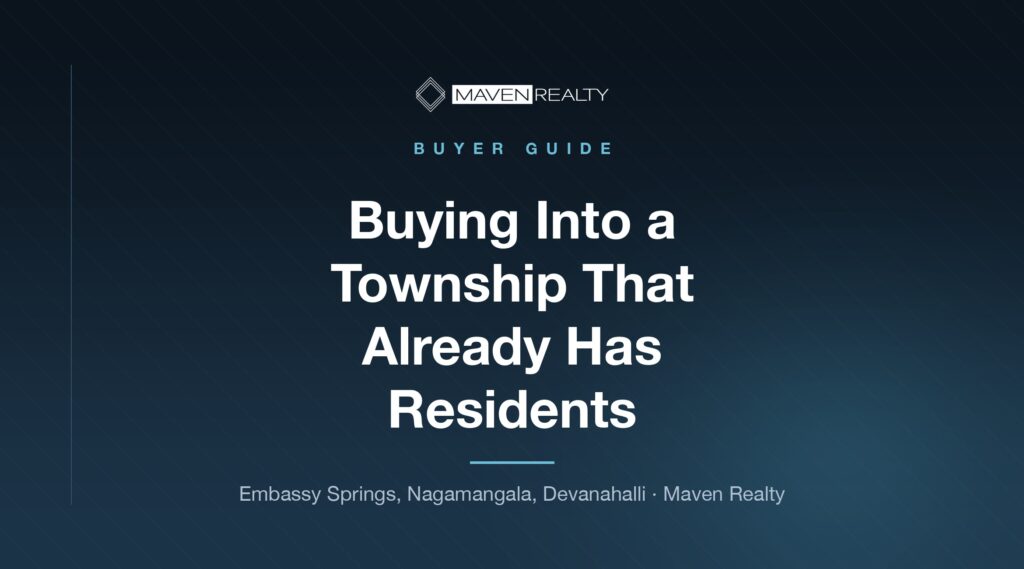
Most township buyers are asked to believe a drawing. A few get something far better — a township where earlier phases are already occupied, so the promise can be walked through. Embassy Greenshore sits inside one of those. If you are ever offered this position, here is how to use it properly.
Key takeaways
- An occupied township is testable evidence, not a masterplan drawing.
- Residents of earlier phases will tell you what arrived and what did not.
- Compare the current masterplan against the original one — the gap is the finding.
- Check maintenance rates residents actually pay, not projections.
- Occupied phases also mean less construction ahead of you, not none.
The example: Embassy Greenshore — a 14.3-acre phase inside the 288-acre Embassy Springs, where several phases are named as completed or ongoing. Details on the listing page.
Why this position is rare and valuable
The central problem with buying into a township is that you are pricing things that do not exist. A school, a clubhouse, a retail row, a park — all drawn, none built.
Where earlier phases are occupied, that changes entirely. The developer has already demonstrated what it does after the apartments are sold, which is the only part of a township that is genuinely hard.
You can see whether the landscaping was planted and maintained, whether the retail has tenants, whether the clubhouse opened, and whether the roads inside the township are as good as the render suggested.
You can also see how the buildings have aged, how the parking works in practice, and whether the place feels cared for on an ordinary Wednesday.
Almost no other property research delivers that much for an afternoon of your time, and most buyers in this position never do it.
The original masterplan test
This is the single sharpest thing you can do, and it takes twenty minutes of searching plus a site visit.
Find the masterplan the township was marketed with when its first phase launched. Old brochures, archived pages and early listing sites usually still carry it.
Then compare it against the current masterplan and against what physically stands there.
| What you are comparing | What it tells you |
|---|---|
| Original plan vs current plan | What has been quietly revised or removed |
| Current plan vs what is built | What is still outstanding |
| Promised dates vs actual delivery | How this developer performs on time |
| Non-residential components | The hardest part — did retail and school arrive? |
A township where the original plan’s school, retail and clubhouse all exist is telling you something no sales presentation can. One where they became additional towers is telling you something too.
Be fair about what you find. Some revisions are sensible responses to changed conditions rather than broken promises, and a developer that replaced an unviable retail block with something better used has made a good decision.
What you are looking for is the pattern rather than any single change. Consistent delivery of the hard components is the signal; consistent quiet removal of them is the other signal.
Talk to residents, and ask the right five things
People who bought an earlier phase have already lived through everything you are about to. They have no commercial interest in your decision and they are usually happy to talk.
- How late was handover against the date you were given?
- How did snagging go — was it resolved, and how long did it take?
- What do you actually pay in maintenance, per square foot per month?
- What was promised that has not arrived?
- What would you check if you were buying here again?
Question three is the one that most changes a buyer’s arithmetic, because projected maintenance rates quoted at booking and actual rates two years after handover frequently differ — see CAM, corpus and sinking fund.
Question five gets you the most useful answer in the whole conversation, because it is the question people have actually thought about.
Find residents at the clubhouse, in the park at the weekend, or through a residents’ group. It is a normal thing to do and most people respond well to being asked.
What being later in the queue actually buys you
There are real advantages to buying a later phase, and they are rarely spelled out.
Less construction ahead of you. Not none — but a buyer in phase five faces fewer remaining phases than one who bought phase one did.
Amenities may already exist. Where the clubhouse and retail were delivered with earlier phases, you move into a functioning place rather than paying maintenance for a construction yard — see Lodha Beaumont Estate vs Prestige Parklane.
Price discovery exists. Earlier phases have resold, so there is actual transaction data in the township rather than guesswork.
The association exists. You can read its accounts, its rules and its track record rather than trusting a draft.
Against that, you usually pay more than the first buyers did, and the best positions in the township — the lakeside, the park frontage — have generally gone.
The mistake to avoid
The obvious trap is assuming that because the township has delivered so far, it will keep delivering. That is a reasonable inference, not a guarantee.
Conditions change. A developer that built a clubhouse in 2020 is not contractually committed to building a hospital in 2031, and market conditions between now and then are unknowable.
So use the evidence for what it is: strong support for the developer’s intent and capability, and no substitute for checking what is sanctioned for the components you are paying for.
The discipline stays the same as on any township: value your home as though only your phase gets built, and treat everything outstanding as upside — the difference is that here, the upside has a track record behind it.
See how to judge a township promise for the full evidence hierarchy.
One last practical note. Take photographs on your visit, dated, of whatever you are relying on — the retail trading, the clubhouse open, the landscaping mature.
If you later find yourself in a conversation about what the township was like when you bought, a dated record is worth considerably more than a recollection.
Common questions
Is it better to buy in a township that is partly built?
It is a far stronger position for research, because you can walk earlier phases, see whether promised components were delivered, read the association’s track record and talk to residents who have lived through handover. You usually pay more than first-phase buyers did.
How do I check what a township actually delivered?
Find the masterplan it was marketed with at first launch, from archived pages or old brochures, then compare it against the current plan and against what physically stands there. The gaps are the finding, especially in non-residential components.
What should I ask residents of an earlier phase?
How late handover was, how snagging went, what they actually pay in maintenance per square foot, what was promised that has not arrived, and what they would check if they were buying there again.
Are later phases of a township better to buy?
They usually mean less remaining construction, amenities that may already exist, real price discovery from earlier resales, and an association you can assess rather than trust. Against that, prices are higher and the best positions have generally gone.
Does a good track record guarantee the rest gets built?
No. It is strong support for intent and capability, not a commitment. Conditions change over a decade, so still check what is sanctioned for the components you are paying for and value your home as though only your phase completes.
Buying into a part-built township?
Send us the township and we will find the original masterplan, compare it against what stands there today, and tell you exactly which promised components arrived. No charge.
Related reading
Figures above are drawn from published project information and are indicative. Where sources conflicted we have stated both positions rather than picking one. Verify any registration yourself on the Karnataka RERA portal before paying a booking amount.