North Bengaluru has three airfields within a short drive of each other: Kempegowda International Airport, Jakkur aerodrome and the Indian Air Force’s station at Yelahanka. Every tall building near them needs a height clearance. If a builder promises an “iconic” high-rise around Yelahanka, the number of floors you’re shown is only as good as that clearance. Here’s how the height NOC works, why Yelahanka is a special case, and what to ask before you book a flat on a high floor.
Key takeaways
- Buildings near civil airports need height clearance under the Ministry of Civil Aviation’s 2015 height rules, through the Airports Authority of India (AAI)
- Air Force Station Yelahanka is a defence airfield, so the defence side has its own say on what can rise nearby
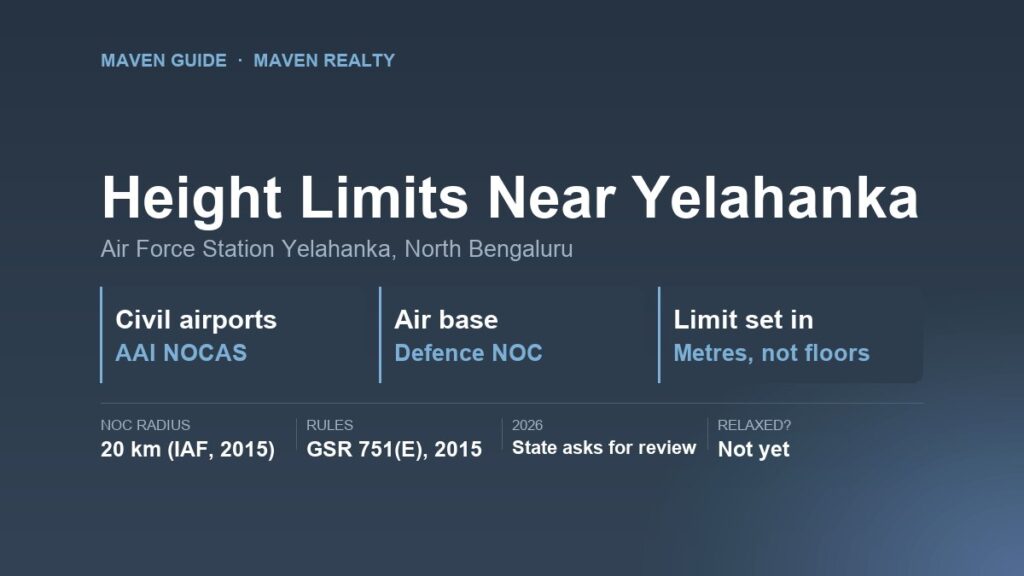
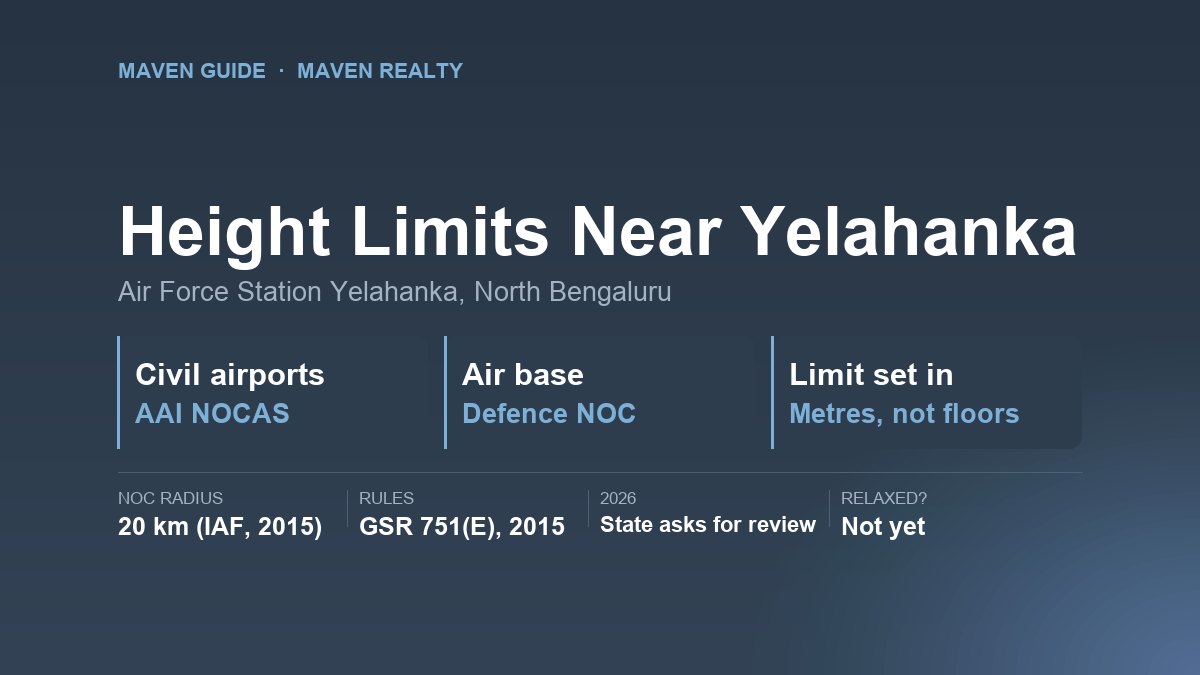
- An IAF officer said in 2015 that every construction within 20 km of the Yelahanka station needs an NOC
- In April 2026 Karnataka’s deputy chief minister asked the Defence Minister to ease what he called excessive restrictions; no change has been reported
- Ask for the height NOC number and the approved floors before you pay anything, not after
Looking at a specific project? Our Shriram Apartments Yelahanka page covers Shriram’s planned 6.5-acre apartment project, which Shriram calls “an iconic addition to the city’s skyline”, with the expected price and RERA status.
In this guide
Why Building Height Restriction in Yelahanka Matters
Aircraft need clear airspace to take off, land and circle. A tower in the wrong place, or a crane that’s taller than planned, can sit right inside that airspace. So India limits how tall a structure can be around every aerodrome, and that’s where the building height restriction in Yelahanka comes from. The limit gets tighter the closer you are to the runway and the flight path.
That limit isn’t set in floors. It’s set in metres, and the floor count follows from it. A building that’s allowed, say, 50 metres above ground gets roughly 16 floors at about 3 metres a floor. That’s our illustration, not a limit anyone has published for Yelahanka.
For a buyer, the practical point is simple. The approved height decides how many floors get built, and the number of floors decides how many flats the builder has to sell on that land.
How the AAI Height System Works
Around civil airports, the rules are the Ministry of Civil Aviation (Height Restrictions for Safeguarding of Aircraft Operations) Rules, 2015, notified as GSR 751(E). The Airports Authority of India runs them.
Under those rules, the AAI publishes colour-coded zoning maps for airports. The map splits the area into grids, and each grid shows a permissible top elevation, measured in metres above mean sea level. To work out how tall you can build, you subtract the ground level of your plot (also above mean sea level) from that top elevation.
If the building stays under the permitted top elevation of its grid, the maps are designed so a separate NOC isn’t needed. If it goes above, or the grid is in a restricted colour, the builder applies online through the AAI’s NOCAS portal, giving the site’s coordinates and ground elevation. The AAI then issues a NOC with a permitted height, or refuses.
The NOC carries a reference number and a permitted top elevation. That’s the document you want to see.
Yelahanka Air Force Station Height Limit: Why It’s Different
Air Force Station Yelahanka isn’t a civil airport. It’s an IAF base, best known to the public as the venue for the Aero India air show. A 2015 report described it as the IAF’s main transport and helicopter training base, training pilots and navigators for the IAF, Navy and Coast Guard.
Defence airfields add a second layer. The AAI’s maps deal with civil aerodromes; near a military airfield, the defence authorities also have to clear tall buildings. In that same 2015 report, an IAF officer said every construction within a 20 km radius of the station needs an NOC. Senior officers also said the station was detecting violations, and pointed to 50-metre cranes at sites nearby.
The civic side reflects this too. BBMP’s published checklist of building-plan NOCs lists a clearance from HAL, Jakkur Flying School or Air Force Station Yelahanka for buildings above a set height, alongside AAI clearance near the international airport. We couldn’t open the current version of that checklist when we checked, so ask the plan-sanctioning authority which NOCs your project needed.
That’s the honest negative for anyone buying high near Yelahanka: you’re dealing with civil rules, defence rules and the city’s plan sanction at once. A builder who has all three in hand is in a very different place from one who expects to get them.
The 2026 Push to Ease Height Limits
Height limits around Bengaluru’s airfields became a political issue in 2026. In March, the Karnataka government was reported to have asked the Centre to review height limits near Kempegowda International Airport, HAL Airport, Jakkur and the Yelahanka air base.
In April 2026, Deputy Chief Minister D.K. Shivakumar met Defence Minister Rajnath Singh in New Delhi and handed over a letter about building curbs around defence airfields, naming HAL Airport and Yelahanka Air Force Station. He called the restrictions on NOCs within 20 km of defence airports “excessive”. The defence side reportedly said existing rules allow extra restrictions based on safety calculations, and the Greater Bengaluru Authority reportedly told the state that stricter norms were being applied in recent clearances.
No decision had been reported when we checked in November 2026. So plan around today’s rules, not a hoped-for relaxation.
What It Means for a Flat Buyer
Most of the risk sits with projects that aren’t approved yet. Once a building plan is sanctioned and filed with RERA, the floors are on record, and the builder can’t change the sanctioned plan without the consent of two-thirds of the buyers under section 14 of the RERA Act.
Before that, at pre-launch, nothing is on record. A brochure can show 30 floors that the height NOC later trims. If that happens, the builder may redesign, add towers, shrink the open space or change the price.
Shriram’s planned apartment project beside the proposed Madappanahalli park near Yelahanka is at that stage. Shriram has said it will be “an iconic addition to the city’s skyline” but hasn’t given a floor count, and its August 2026 investor deck says plan submission is in progress. It’s expected to start around ₹1.1 Cr*. Ask for the height NOC as soon as there’s a RERA filing.
If you want a project in the same belt that’s already registered, Assetz Zen & Sato on Bagalur Main Road has its approved plan on the RERA portal, so you can read its floors there.
And if you’re also weighing pre-launch projects towards the airport, Purva Codename Infinity at Chikkajala is another one where the same questions apply.
*Expected price, excluding GST, stamp duty and registration. Ask us for the latest cost sheet for a named unit before you pay a booking amount.
Six Questions to Ask About a High-Rise Near Yelahanka
- What’s the height NOC reference number? And which body issued it: the AAI, the defence authorities, or both?
- What permitted top elevation does it give? In metres above mean sea level, and the plot’s ground level.
- How many floors does the sanctioned plan show? It should match the brochure.
- Is the plan filed on RERA? Look up the registration and download the sanctioned drawings.
- Which tower and floor am I buying? If a tower is cut, ask what happens to your unit.
- What’s in the agreement if floors change? Get the refund or reallocation terms in writing.
FAQs
Is there a building height restriction in Yelahanka?
Yes, there is a building height restriction in Yelahanka. Yelahanka is close to Air Force Station Yelahanka, Jakkur aerodrome and Kempegowda International Airport, so tall buildings need height clearance. The limit depends on the exact location and is set in metres, not floors.
What is AAI NOCAS?
It’s the Airports Authority of India’s online system for height clearance. Builders submit the site’s coordinates and ground elevation and receive a NOC with a permitted top elevation.
How far from Yelahanka Air Force Station do you need an NOC?
An IAF officer said in 2015 that every construction within 20 km of the station needs one, and the state government referred to the same 20 km range in 2026. Check with the plan-sanctioning authority for your site.
Have the height limits around Bengaluru been relaxed?
Not as of November 2026. Karnataka asked the Centre to review them in March and April 2026, but no change had been announced.
Can a builder reduce floors after I book?
Before RERA registration, plans can change freely. After registration, changes to the sanctioned plan need two-thirds of buyers to agree under section 14 of the RERA Act.
What we checked (5 November 2026): the Ministry of Civil Aviation height rules of 2015 (GSR 751(E)) and how AAI’s colour-coded zoning maps and NOCAS work; a 2015 report quoting IAF officers at Yelahanka; reports from March and April 2026 on Karnataka’s request to the Centre; BBMP’s NOC checklist as indexed; and Shriram’s September 2025 press release and August 2026 investor deck.
We haven’t found a published height limit for any specific site near Yelahanka, and we don’t give one. The floors-from-metres figure is our illustration.
General information, not legal or financial advice. Prices are indicative and can change; get a written cost sheet before you pay anything.
Checking a high-rise near Yelahanka? Talk to us
We’ll find the RERA filing, the sanctioned floors and a written cost sheet for a named flat.