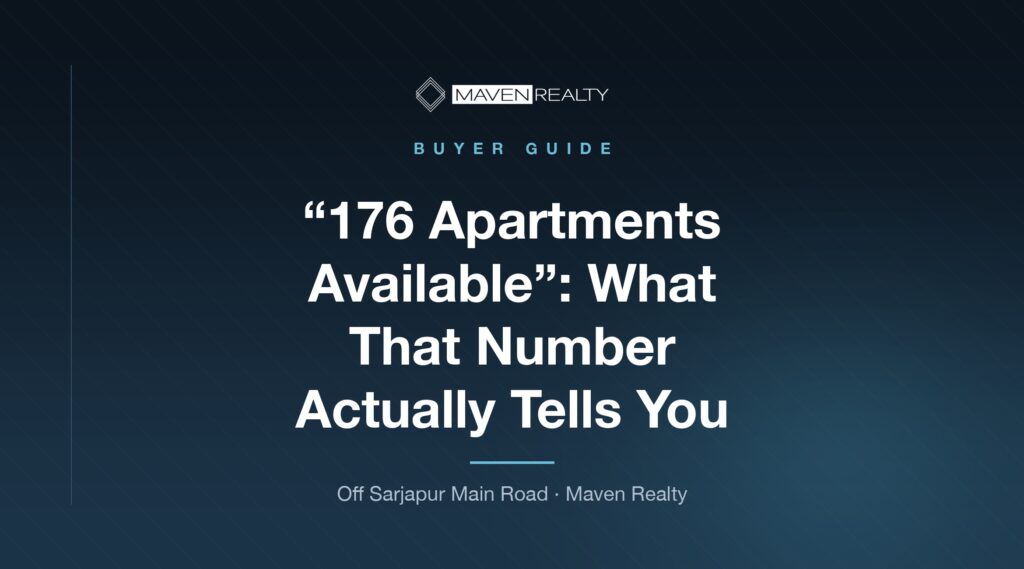
Sobha’s own listing for Sobha Altair says “176 Apartments Available”. Against a reported total of around 207, that implies roughly 31 sold. Availability figures are published far more often than sales figures, and they tell you something useful about a project — if you read them carefully.
Key takeaways
- Available is inventory unsold now. Total is the project size. Different numbers.
- Total minus available gives you a rough absorption figure.
- Absorption tells you about demand at that price on that corridor.
- Availability is a snapshot and moves. Note the date you read it.
- Low availability means less choice, not necessarily a better project.
The example: Sobha Altair — 176 shown available against a reported ~207 total. The listing page sets out both figures and their sources.
The two numbers and why they get confused
Developers publish availability because it is a sales tool. It creates urgency and it tells a buyer what they can still choose from.
They rarely publish sales or absorption directly, because that is commercially sensitive and because a slow number is bad marketing.
So you get one half of a subtraction. If you can find the total unit count — from a RERA filing, a press release or secondary sources — you can complete it.
Total minus available equals sold, approximately. Approximately, because “available” may exclude units held back for later release, staff allocations or unsold inventory not yet on the price list.
That caveat matters, so treat the result as an indication rather than a figure. It is still considerably more than you had before.
There is a second reason the subtraction can mislead. Some projects count a unit as sold on an expression of interest rather than a registered agreement, and those are not the same commitment.
Ask whether the sold figure reflects booked units or registered ones. On a pre-launch or early-launch project the difference can be substantial.
What a high or low availability actually means
Neither is straightforwardly good or bad, and it is worth resisting the obvious reading.
| Situation | What it might mean | What it means for you |
|---|---|---|
| Most units available, recent launch | Normal early stage | Best choice of unit and position |
| Most units available, launched long ago | Slow absorption | Ask why. Negotiating room. |
| Few units available | Strong demand, or small release | Little choice; check what is left and why |
| Availability rising over time | Cancellations, or a new phase released | Worth asking which |
The second row is the useful one. A project that launched two years ago with most inventory unsold is telling you something about pricing or product that nobody will say out loud.
The third row has a trap. “Only a few left” may mean the project sold well, or it may mean only a small tranche has been released, with more coming. Those are opposite situations described identically.
How to use absorption properly
Absorption is most informative when you compare it against something rather than reading it alone.
Against time since launch. Thirty units in three months is a different story from thirty units in two years. Get the launch date, which is embedded in the RERA number.
Against the corridor. If comparable projects nearby are absorbing faster at similar prices, ask what is different about this one.
Against configuration. Ask which configurations are selling. If the 3 beds are gone and the 4 beds are not, that is the market telling you where the value is.
That third one is the most actionable, and sales teams will usually answer it because it helps them sell what is left.
Our guide to decoding a Karnataka RERA number shows how to get the registration date out of the number itself, which gives you the denominator.
Why slow absorption is not automatically a warning
Being fair here, because it is easy to read a slow number as a red flag when it often is not.
Premium projects absorb more slowly by nature. There are simply fewer buyers at ₹3 Cr than at ₹1 Cr, so a small high-end project takes longer to sell out and that is expected rather than concerning.
Long handover horizons also slow absorption. A 2031 completion narrows the buyer pool to people comfortable waiting five years, which is a smaller group.
And developers sometimes deliberately hold inventory, releasing in tranches to manage pricing. Slow reported absorption can be a pricing strategy rather than weak demand.
What would concern us is slow absorption on a mid-priced project, on a strong corridor, well after launch, with no obvious explanation. That combination is worth asking about directly.
In every case the right move is to ask rather than infer. “How has absorption been, and which configurations are moving?” is a normal question and the answer is informative either way.
And if absorption genuinely has been slow, that is often good news for you rather than bad. A developer carrying unsold inventory has more reason to be flexible on payment terms, floor rise or included items than one selling out.
A caution about how these numbers behave
Three things to keep in mind so you do not over-read what you find.
Availability is a snapshot. It changes weekly. Note the date you read it, because comparing today’s figure against one you remember from a month ago is the only way to see a trend.
Definitions vary. One developer’s “available” is everything unsold; another’s is only what is currently released for sale. Ask which.
Totals are often uncertain. If the total comes from secondary sources and the availability from the developer, you are subtracting two numbers of different quality. Get the total from the RERA filing instead, where the block and unit counts are declared.
Done that way — developer availability against filed totals, dated — the subtraction is genuinely useful and almost nobody does it.
Our guide to reading a RERA filing covers where to find the declared unit count.
One final use for availability that has nothing to do with judging the project: it tells you how much choice you have. Low availability on a large project often means the best positions have gone, whatever the headline number says.
So ask not just how many are left but which ones. A hundred units available in the towers nobody wants is a different proposition from twenty spread across the best facings.
Common questions
What is the difference between available and total units?
Available is the inventory unsold at the moment you read it. Total is the project size. Subtracting one from the other gives a rough absorption figure, though availability may exclude units held back for later release.
What does slow absorption in a project mean?
Not automatically a problem. Premium projects absorb more slowly because there are fewer buyers at high ticket sizes, long handover horizons narrow the pool, and developers sometimes hold inventory deliberately to manage pricing.
Does “only a few units left” mean a project sold well?
Not necessarily. It may mean strong demand, or it may mean only a small tranche has been released with more to come. Those are opposite situations described identically, so ask which applies.
How do I work out how long a project has been selling?
The registration date is embedded in the Karnataka RERA number as six digits in DDMMYY form before the serial. That gives you the denominator for judging whether an absorption figure is fast or slow.
Which absorption question is most useful to ask?
Which configurations are selling. If the smaller units have gone and the larger ones have not, the market is telling you where the value sits, and sales teams will usually answer because it helps them sell what remains.
Want to know how a project is really selling?
Send us the project and we will get the filed total from the RERA record, the current availability, and the registration date, so you can see absorption against time. No charge.
Related reading
Availability figures are snapshots that change frequently and definitions vary between developers; the figures cited reflect what was published on the date we read them. Figures above are drawn from published project information and are indicative. Verify any registration yourself on the Karnataka RERA portal before paying a booking amount.