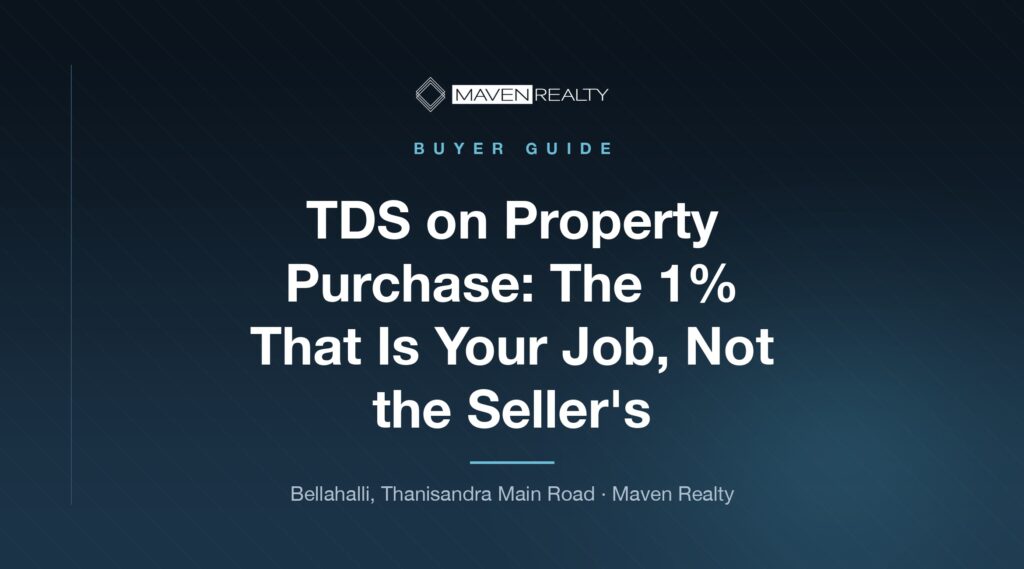
Buy a home above ₹50 lakh in India and you — the buyer — are legally required to deduct tax at source and deposit it with the government. Not the seller. Not the bank. You. Almost no first-time buyer knows this until a bank or a lawyer mentions it late, and getting it wrong carries interest and penalty.
Key takeaways
- On a purchase above ₹50 lakh, the buyer deducts 1% TDS under section 194-IA.
- It is deducted from the seller’s money and paid to the government, using Form 26QB.
- It applies to the whole consideration once the threshold is crossed, not just the excess.
- On instalments, you deduct on each payment as it is made.
- Buying from a non-resident seller is a different, much heavier regime entirely.
Why this comes up: Nikoo Homes 8 — where a reported ₹94 lakh entry price registers at about ₹1.06 crore once every statutory charge is added. Full cost sheet on the listing page.
What the rule actually says
Section 194-IA of the Income Tax Act requires the buyer of immovable property to deduct tax at source when the consideration crosses a threshold of ₹50 lakh.
The rate is 1% of the consideration, and the obligation sits with the buyer rather than the seller. You deduct it from what you would otherwise pay the seller, and you deposit it with the government on their behalf.
The mechanism is Form 26QB, a challan-cum-statement filed online. After filing, you issue the seller Form 16B as proof that the tax was deducted and deposited against their PAN.
Agricultural land is outside the provision. Most residential and commercial property purchases above the threshold are inside it.
The important structural point: once the threshold is crossed, the 1% applies to the entire consideration, not merely the amount above ₹50 lakh.
Why buyers miss it
Three reasons, and all of them are structural rather than careless.
It is not in the price list. Every other charge — GST, stamp duty, registration — appears on the developer’s cost sheet. TDS does not, because it is not a cost the developer collects.
It is not a cost at all, technically. The 1% comes out of the seller’s money, so your total outlay is unchanged. What changes is that you must route part of the payment through the government instead of to the seller, and you must document it.
It sounds like the seller’s problem. The tax is on the seller’s income. The compliance obligation is entirely yours, and the penalty for failing lands on you.
That last asymmetry is the whole issue. A buyer who pays the seller 100% of the price has not saved money — they have failed to deduct, and they remain liable for the amount plus interest.
Developers handle this routinely and will usually tell you. A resale purchase from an individual is where it more often gets missed.
There is one more reason it slips through: joint buyers. Where a property is bought in two names, the compliance is generally handled per buyer and per seller, which multiplies the filings rather than complicating the arithmetic.
That catches couples in particular, who often assume one filing covers the transaction. Ask your advisor how your specific ownership structure should be handled before the first payment goes out.
How it works on an under-construction purchase
This is where it gets practical, because under-construction homes are paid in instalments over years rather than in one transaction.
The deduction is made on each payment as it is made, not once at the end. So if you pay a booking amount, then slab-linked instalments, you deduct 1% from each and file a Form 26QB for each.
That is a recurring piece of admin across the whole construction period, and on a project completing in 2030 it can mean a sequence of filings over several years.
Keep a simple record: date, amount paid, TDS deducted, challan reference, Form 16B issued. You will want it at registration and again if anything is ever questioned.
Also note that the deduction is calculated on the consideration for the property. Other charges billed separately may or may not form part of that figure depending on how your agreement is drafted, which is a question for your own advisor on your own paperwork.
The non-resident seller trap
This is the version that causes real financial damage, and it is worth knowing even if it does not apply to you today.
Where the seller is a non-resident, section 194-IA does not apply. A different provision governs, the rate is very substantially higher than 1%, and it is calculated differently.
A buyer who applies the familiar 1% to a purchase from a non-resident seller has under-deducted badly, and the shortfall plus interest is recoverable from the buyer.
This comes up more often than people expect in resale transactions, particularly in cities with large expatriate Indian ownership.
So establish the seller’s residential status in writing before you structure any payment, and take professional advice for that transaction specifically. This is not a situation to work out from a general article, including this one.
A practical checklist
Six things to do. None are difficult; the difficulty is knowing they exist.
- Establish whether the consideration crosses ₹50 lakh. If yes, the obligation applies.
- Establish the seller’s residential status in writing before structuring payments.
- Collect the seller’s PAN. You cannot file without it, and a missing PAN changes the rate.
- Deduct on each payment, not once at the end, on an instalment purchase.
- File Form 26QB within the prescribed time after each payment and keep the challan.
- Issue Form 16B to the seller and keep a copy with your property file.
On a developer purchase, ask their finance team how they handle it. Large developers do this thousands of times and can usually tell you exactly what they expect.
This is general information, not tax advice. Rates, thresholds and timelines change, and your position depends on your own facts. Confirm with a qualified advisor before acting, particularly on anything involving a non-resident seller.
Common questions
Who deducts TDS when buying property in India?
The buyer. Under section 194-IA, a buyer of immovable property with consideration above the threshold deducts tax at source from the seller’s money and deposits it with the government. The compliance obligation and any penalty sit with the buyer, not the seller.
What is the TDS rate on property purchase?
One percent of the consideration under section 194-IA, where the purchase crosses the fifty lakh threshold. Once crossed, it applies to the entire consideration rather than only the amount above the threshold. A missing seller PAN changes the position.
What is Form 26QB and Form 16B?
Form 26QB is the challan-cum-statement the buyer files online to deposit the deducted tax. Form 16B is the certificate the buyer then issues to the seller as proof the tax was deducted and deposited against their PAN.
Do I deduct TDS on each instalment of an under-construction flat?
Yes. The deduction is made on each payment as it is made rather than once at the end, with a Form 26QB filed for each. On a project completing years later that means a sequence of filings across the construction period.
Is TDS different when buying from an NRI seller?
Substantially. Section 194-IA does not apply where the seller is a non-resident; a different provision governs at a much higher rate calculated differently. Applying the familiar one percent would be a serious under-deduction recoverable from the buyer.
Unsure what you owe beyond the price?
Send us the project and your payment schedule and we will lay out every statutory charge, when each falls due, and what compliance sits with you rather than the developer. No charge.
Related reading
This is general information on how tax deduction at source works on property purchases, not tax or legal advice. Rates, thresholds and procedures change and individual positions differ, so confirm with a qualified advisor before acting. Figures above are drawn from published project information and are indicative. Verify any registration yourself on the Karnataka RERA portal before paying a booking amount.