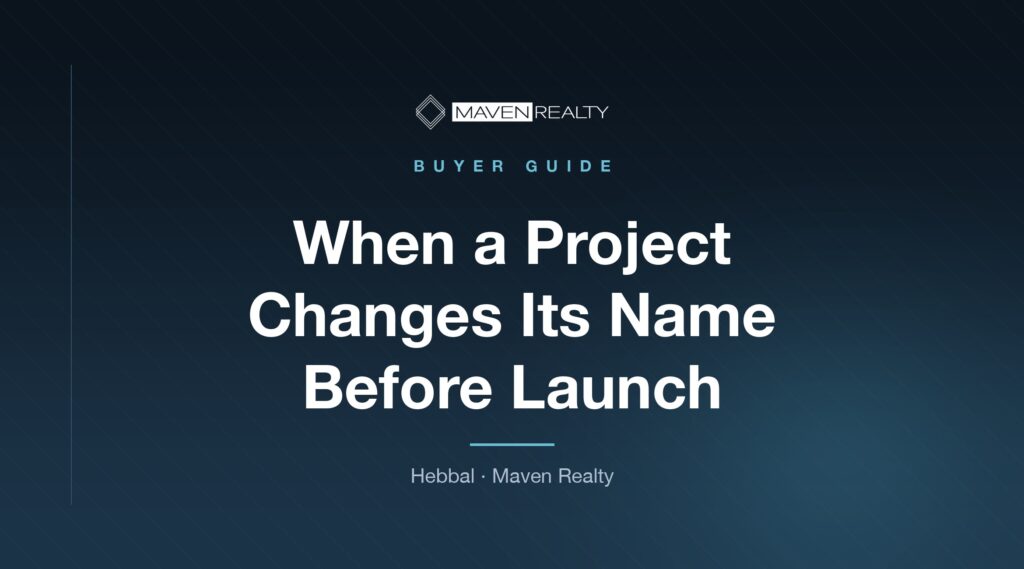
Embassy’s own announcement describes this project as “Embassy Astra, project to be named as Embassy Sky Terraces“. A project changing its name between announcement and launch is ordinary. What is not ordinary is how much confusion it causes in your paperwork, your searches and your due diligence if you are not watching for it.
Key takeaways
- Projects are renamed between announcement and launch routinely.
- The RERA filing name is the one that governs. Everything else is marketing.
- Make sure every document uses the same name, or references the survey numbers.
- Your searches will miss information filed under the other name. Search both.
- A rename is not a warning sign by itself — but unexplained renames are worth asking about.
The example: Embassy Astra — announced as Astra, to be named Sky Terraces, at Hebbal. Our listing page uses both names throughout for exactly this reason.
Why developers rename projects
There are several ordinary reasons, and none of them are sinister.
Internal versus market names. A project carries a working name through land acquisition and design, then gets a marketing name at launch. Astra to Sky Terraces looks exactly like this.
Brand family alignment. Developers group projects under sub-brands, and a name may change to fit a range being built out across a city.
Trademark and availability. Names get cleared late, and a preferred name sometimes turns out to be unavailable.
Repositioning. A project aimed at one segment during planning may be repositioned before launch, and the name follows the positioning.
What all of these have in common is that the land, the approvals and the sanctioned plan are unchanged. The name is a label on the same asset.
It is worth noting that phases within one project often carry different names too, which produces the same effect without anything being renamed at all.
The paperwork problem
Here is where a rename actually costs you something, and it is worth being systematic about it.
Your transaction generates a chain of documents: expression of interest, allotment letter, agreement to sell, construction agreement, loan sanction, sale deed, khata. If different documents name the project differently, you have a reconciliation problem later.
The anchor is not the name at all. It is the survey numbers and the RERA registration number, both of which identify the land and the registered project regardless of what it is called.
So the discipline is straightforward: make sure every document carries the survey numbers and the registration number, and make sure the name used is consistent or explicitly cross-referenced.
If a document names the project differently from the RERA filing, ask for a clarificatory reference in writing tying the two together. It is a small thing to ask at signing and a tedious thing to sort out at resale.
Our guide to how Karnataka records land extents covers reading survey numbers and extents in those documents.
The research problem
A rename fragments the public information about a project, and this catches out buyers doing their own diligence.
News coverage, investor disclosures and early listings use the announcement name. Sales material, aggregator pages and the RERA filing may use the launch name. Neither set of results shows you the other.
So search both. Every time. If you only search the name on the hoarding, you will miss the press release that carries the revenue figure and the acreage, which is often the most reliable public information available.
On the project that prompted this article, that is exactly where the useful numbers were. The announcement name led to Embassy’s own disclosure of land area, unit count and estimated revenue; the launch name led mostly to channel partner pages.
Add the locality and the developer name to your searches too, since some coverage identifies a project by neither name — just “Embassy’s Hebbal project”.
When a rename is worth asking about
Most renames are housekeeping. A few are worth a question, and it is easy to tell them apart.
Ordinary: a working name becoming a marketing name at launch, announced openly, with the land and approvals unchanged. That is the common case and it needs no explanation.
Worth a question: a rename after sales have started, particularly if it follows a delay, a dispute or negative coverage. Renaming a project that has a history can have the effect of detaching it from that history in search results.
Also worth a question: a rename accompanied by a change in the registered promoter entity, or by a fresh registration replacing an older one. That is a more substantive change than a name.
The way to check is to search the developer and locality rather than either name, and to look at the RERA portal for the promoter’s registration history at that location.
If a project has been registered twice under different names, the filings will show it, and the reasons are worth understanding before you buy.
A short checklist
Six things, and they take one conversation plus twenty minutes of searching.
- Ask what name the agreement will use, and whether that matches the RERA filing.
- Get the survey numbers and check they appear on every document.
- Get the registration number and check the project name on the portal against your paperwork.
- Search both names plus the developer and locality, every time you research.
- Ask when the rename happens relative to your signing, so you know which name your documents will carry.
- If the rename follows a delay or dispute, ask directly what changed beyond the name.
Done at the start, this is trivial. Done at resale, when a buyer’s lawyer finds two names in your chain of documents, it is not.
The name is the least important thing about a project and the easiest to get wrong on paper. Anchor everything to the survey numbers and the registration, and the label stops mattering.
One last practical note for anyone buying a resale flat in a renamed project. Ask the seller for the original allotment letter as well as the sale deed, because the chain of title may run through the old name and a lender will want to see how the two connect.
Sellers often no longer have the earlier documents, which is a good argument for keeping yours. Put them somewhere you will find them in fifteen years.
Common questions
Why do property projects change their names before launch?
Usually because a working name used during land acquisition and design is replaced by a marketing name at launch. Brand alignment, trademark availability and repositioning are other ordinary reasons. The land, approvals and sanctioned plan are unchanged.
Which project name is legally binding?
The name on the RERA filing governs, but the real anchors are the survey numbers and the registration number, which identify the land and registered project regardless of what it is called. Make sure both appear on every document.
What should I check if a project has two names?
That every document carries the survey numbers and registration number, that the name used matches the RERA filing or is explicitly cross-referenced, and that your loan sanction and agreement do not name the project differently from each other.
Is renaming a project a warning sign?
Usually not. A working name becoming a marketing name at launch is routine. A rename after sales have started, especially following a delay or dispute, or one accompanied by a change of promoter entity or a fresh registration, is worth asking about.
How do I research a project that has been renamed?
Search both names, plus the developer name with the locality, since some coverage uses neither name. Announcement-name searches often surface the developer’s own disclosures, which carry the most reliable figures.
Two names on your paperwork?
Send us the documents and we will check the names, survey numbers and registration all tie together before you sign. It is a quick check that saves real trouble at resale, and there is no charge.
Related reading
Figures above are drawn from published project information and are indicative. Where sources conflicted we have stated both positions rather than picking one. Verify any registration yourself on the Karnataka RERA portal before paying a booking amount.